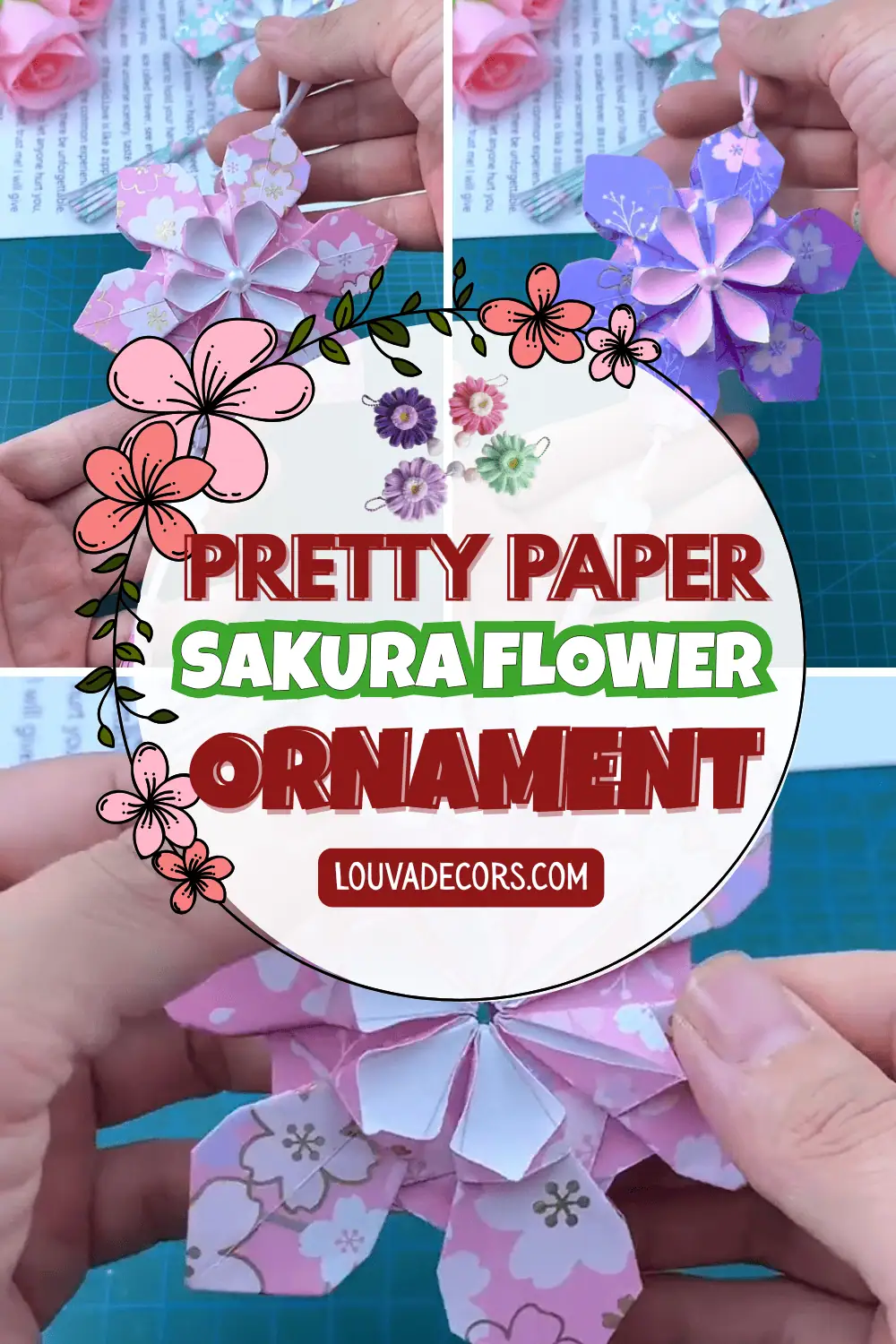

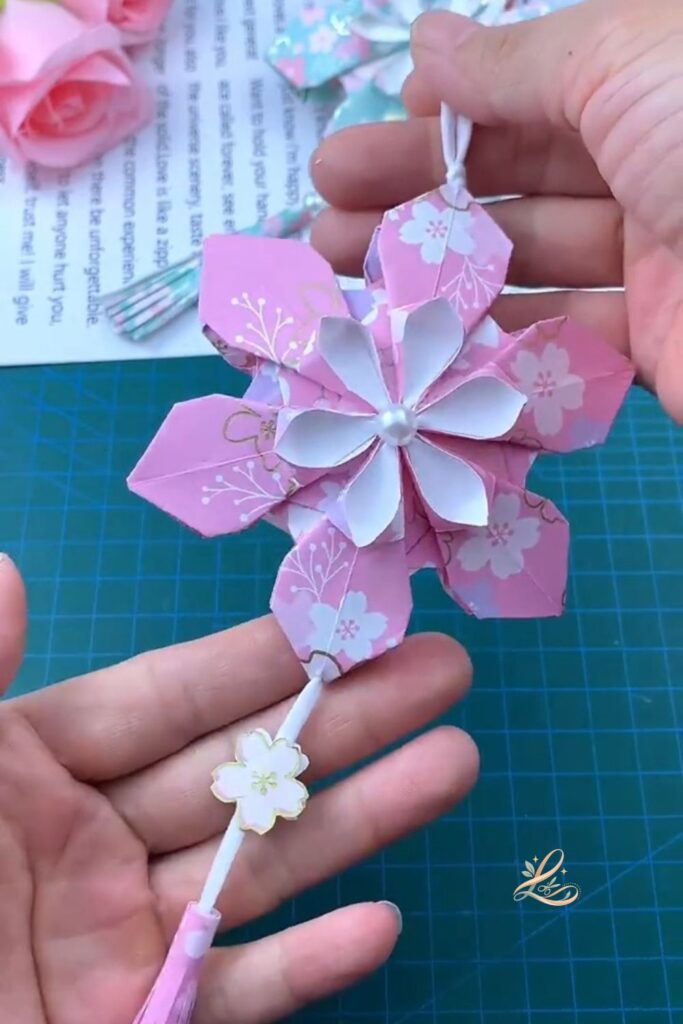
Imagine a delicate cherry blossom the size of your palm, made entirely from paper, hanging from a white ribbon in your window. The petals are full and layered, each one slightly curved and catching the light. At the centre sits a single pearl, and below it a paper tassel sways gently. It looks like something you would find in a Japanese stationery shop and it costs almost nothing to make.
You do not need any origami experience to make this. You do not need special tools. By the end of this post, you will have a step-by-step written guide plus a full video to follow, and everything you need to make your own paper sakura flower ornament completely from scratch.
Gather your patterned origami paper, a glue stick, a pearl brad, some ribbon, and a pair of scissors. The whole project takes around 30 to 45 minutes.
Why You Will Love This Project
This project is made for complete beginners. Each step is just a simple fold, and the modules snap together like puzzle pieces once you see how. It looks incredibly expensive and intricate when finished, but every single piece is cut from regular origami or patterned paper you can find at any craft store. Hang it in a window, on a bag, or give it as a handmade gift, and people will genuinely ask where you bought it. A full video tutorial is included so you can watch every fold before you try it yourself.
What You Will Need
- Patterned origami paper or double-sided paper (pink floral or sakura pattern works beautifully) [or any patterned wrapping paper cut to size, or plain coloured paper]
- Plain white or light-coloured origami paper (for the inner petal layer) [or use the plain side of double-sided origami paper]
- Glue stick [or a small bottle of PVA craft glue applied with a toothpick]
- 1 pearl brad or pearl flatback gem for the flower centre [or a button, a circle sticker, or a small bead glued in place]
- Tweezers [or a toothpick or the tip of a pencil to push the brad through]
- White ribbon or cord, approximately 20 cm [or thin twine, embroidery floss, or any narrow ribbon you have at home]
- Scissors [any household scissors are fine]
- A small paper tassel (pre-made or handmade from paper strips) [optional, but adds a beautiful finishing touch]
- A small cherry blossom die-cut charm or paper sticker for the tassel cord [optional, or skip this detail entirely]
Total estimated cost: $2 to $6
All materials can be found at your local craft store or ordered online. You may already have the paper and glue at home.
Video Tutorial
Watch the full tutorial above before reading the written steps. The written steps below match the video exactly so you can follow along at your own pace.
Steps For Paper Sakura Flower Ornament
Step 1: Cut Your Paper to Size and Fold a Template Module in White
Cut a strip of white paper and fold it into thirds vertically to create a tall, narrow rectangle. This white piece acts as your size guide for the whole project. Having a template module in a plain colour makes it much easier to see exactly where each fold needs to go before you start working on your patterned paper. Hold the folded strip between your fingers and check that it is roughly three times as tall as it is wide. No rush at this stage getting the proportions right now saves you time later.
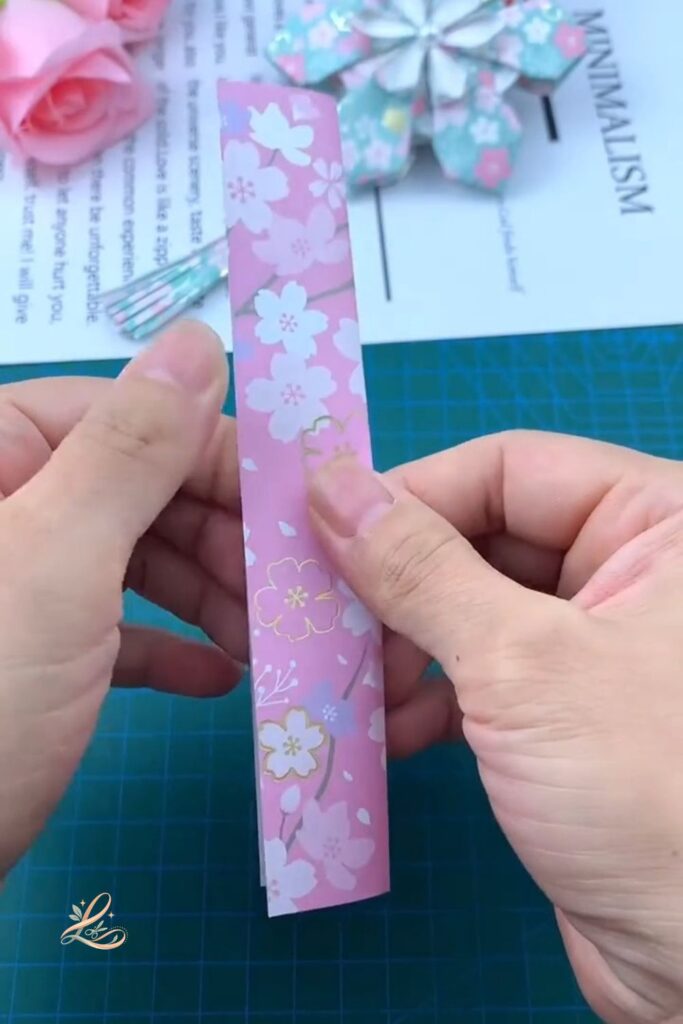
Pro Tip: Keep this white template module in front of you throughout the whole project. Whenever you are unsure of a fold on your patterned pieces, hold your patterned paper next to the white guide and match the shape.
Step 2: Prepare Your Patterned Paper Strip
Cut a strip of patterned origami paper to the same dimensions as your white template and fold it into thirds the same way. Set the white guide next to your patterned piece as a reference. Hold both strips side by side to confirm they are the same width. Once you are happy with the match, set the white guide aside and continue with the patterned strip. You now have one patterned module ready to start folding.
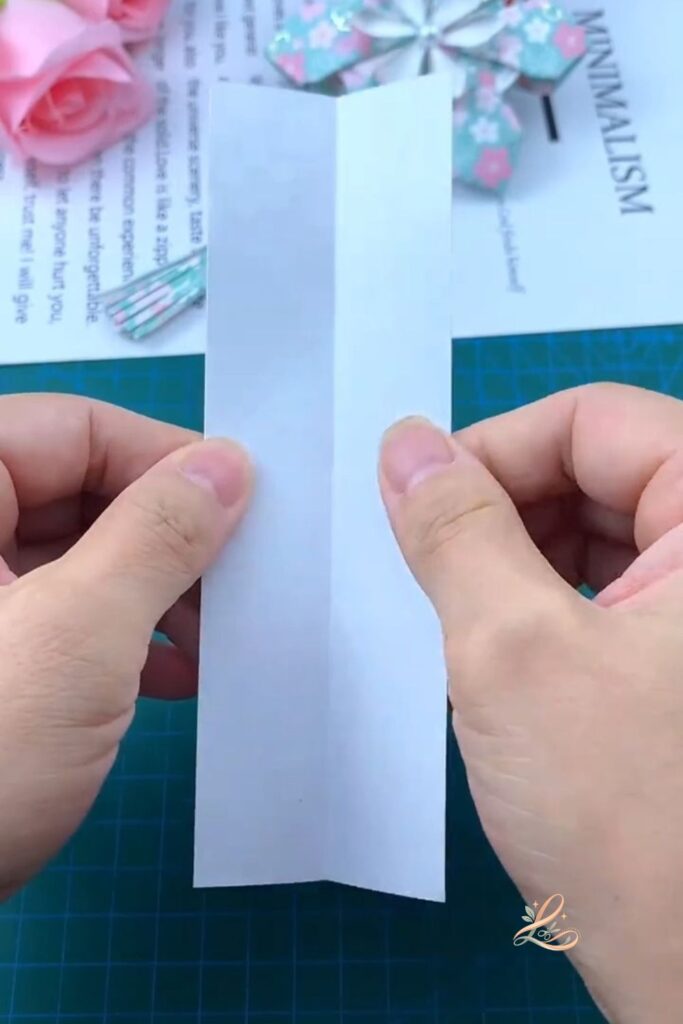
Pro Tip: Cut all six of your patterned strips at the same time before you begin folding. Doing all the cutting in one go means your strips will be consistent in size, and consistent strips are what make the finished flower look neat and symmetrical.
Step 3: Fold the Bottom Corners Up to Create a Diamond Point
Open the folded strip back out flat, then fold the bottom two corners inward so they meet at the centre crease, forming a pointed V shape at the bottom. Press each corner fold firmly with your fingernail. When you look at your piece from the front, the bottom should now come to a neat downward point like the tip of a diamond. This pointed bottom is what gives each finished petal its characteristic cherry blossom shape.
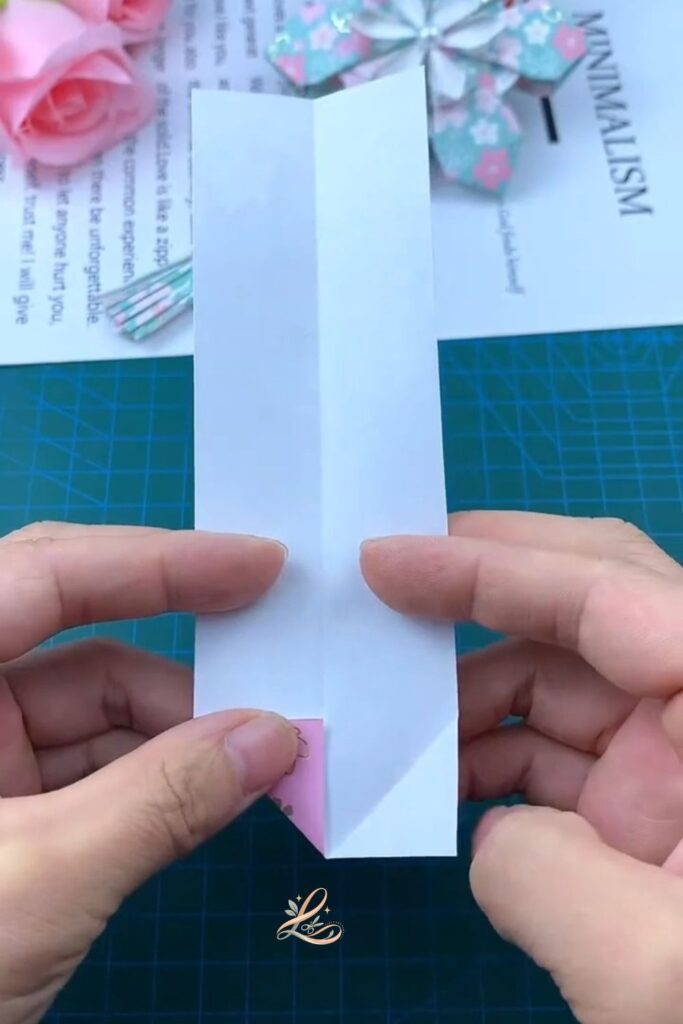
Pro Tip: Make sure both corner folds meet exactly at the centre crease line. If one side is higher than the other, your finished petal module will sit slightly crooked when glued into the flower. It is okay if it is not perfect on your first try. The petals overlap enough to hide any small differences.
Step 4: Fold the Top Corners Inward to Create a Pointed Top
Fold the top two corners inward to meet at the centre crease, mirroring exactly what you did at the bottom. Press the folds firmly. Your module now has a pointed top and a pointed bottom, with the centre section forming a narrow diamond body. Hold it up and check that both points are sharp and centred. This is the full profile of one petal module before it is shaped into 3D.
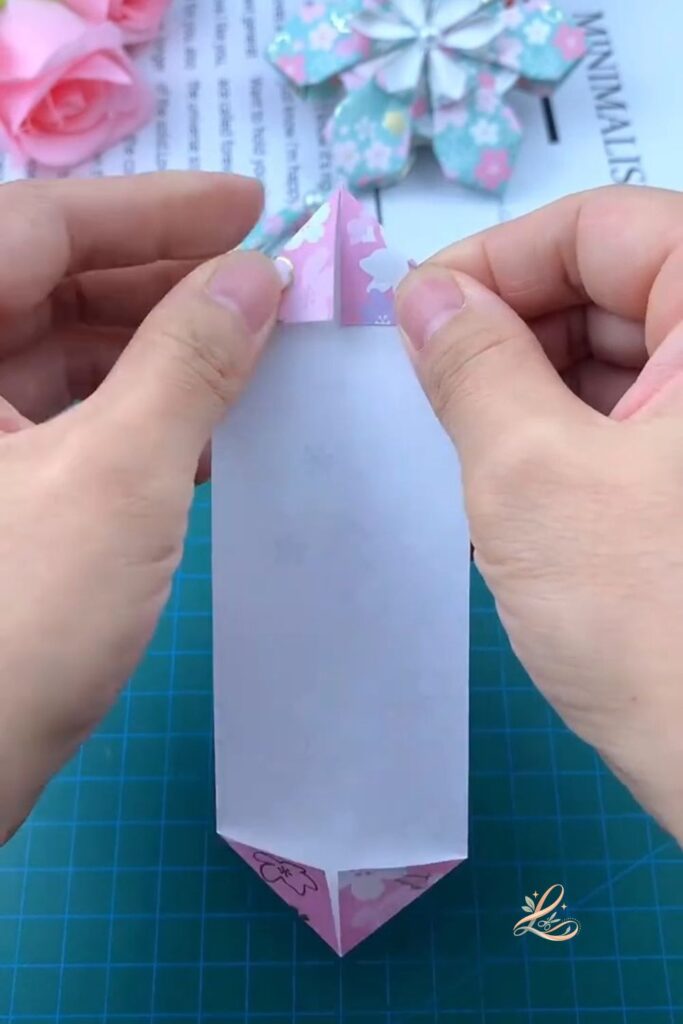
Pro Tip: The top and bottom points do not need to be identical lengths. In the video, the top point is slightly shorter than the bottom. Both work perfectly well. The important thing is that each crease is pressed flat and clean.
Step 5: Fold Down the Top Flap to Reveal the Petal Shape
Turn the module over so the plain white side faces you, then fold the top flap downward along the existing crease. Press firmly. When you turn the module back to the patterned side, you will see the shape of a single petal beginning to emerge: a wide rounded top with the patterned paper curling slightly forward. This fold is what creates the gentle curve at the top of each petal in the finished flower.
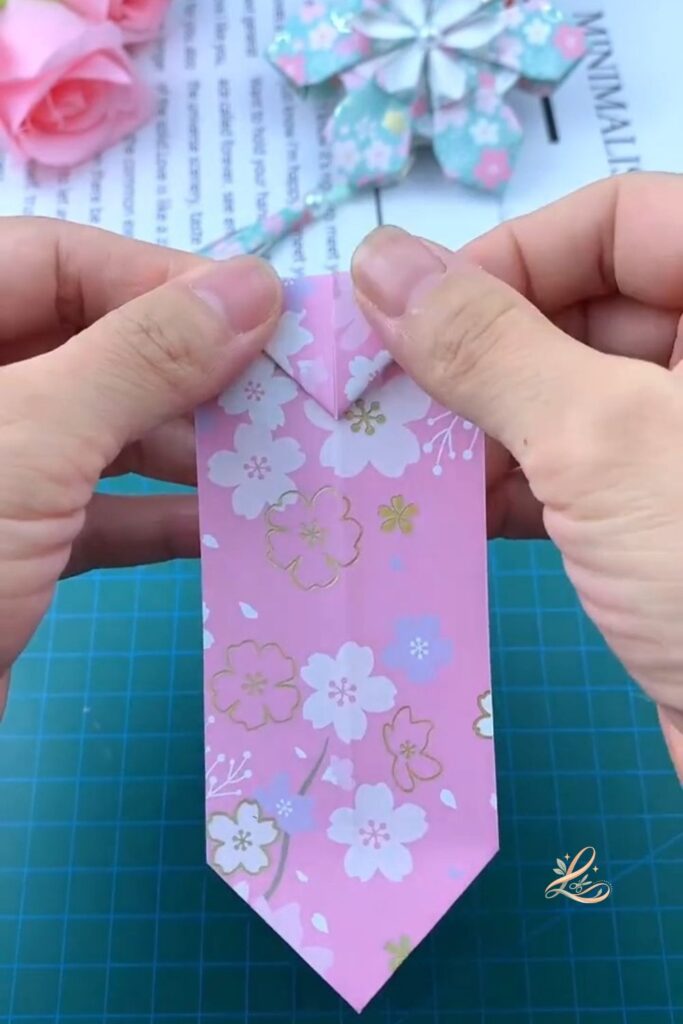
Pro Tip: Take your time pressing this fold. If the top flap is not lying fully flat against the body of the module, the finished petal will gap slightly when you glue the modules together. Run your thumbnail along the crease two or three times to get it as flat as possible.
Step 6: Open the Module into a 3D Petal Shape
Gently press the sides of the module inward with your thumbs while pushing the back of the module outward with your fingers, coaxing it into a three-dimensional box-like petal shape. The module will open up and puff out slightly, like a small square lantern. The patterned side curves outward and the bottom point becomes a small pyramid shape. Hold the module in your palm and check that it looks like a plump, freestanding petal. This is one completed petal module.
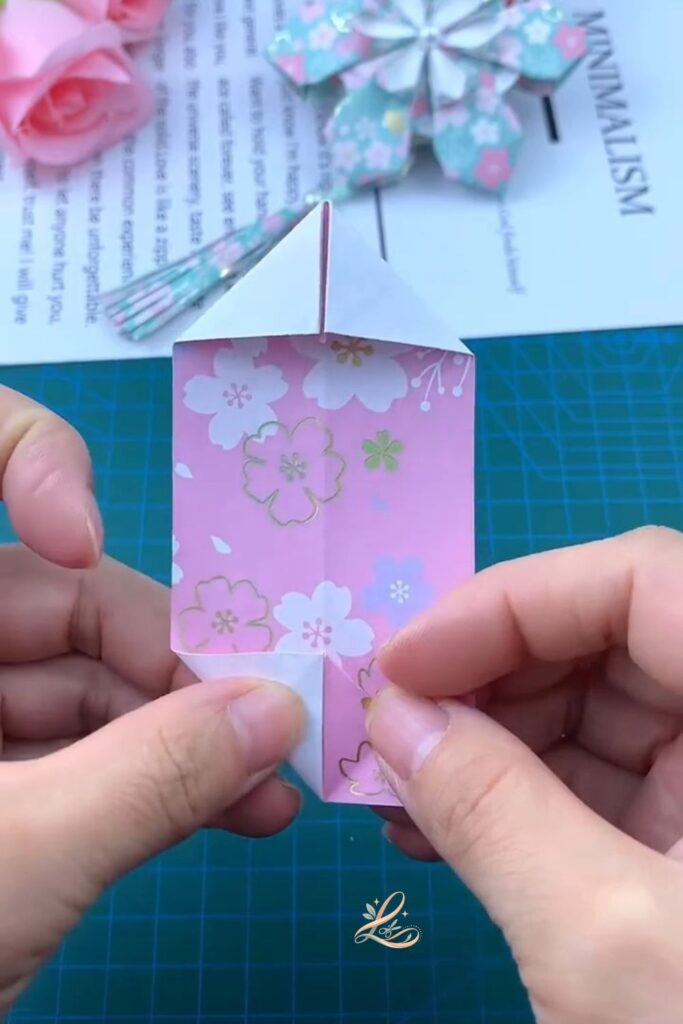
Pro Tip: Do not force the module open too quickly or the paper will crease in the wrong place. Work slowly and use gentle, even pressure from all sides. If the module collapses back flat, just open it again. The paper is very forgiving at this stage.
Step 7: Make Five More Identical Petal Modules
Repeat Steps 2 through 6 five more times until you have six completed petal modules in total. Lay each finished module on the table as you go. By the time you finish the sixth one, you should have a row of six matching 3D petal shapes, all the same size, all standing upright on their flat bases. Take your time, there is no rush at all, and consistency is more important than speed at this stage.
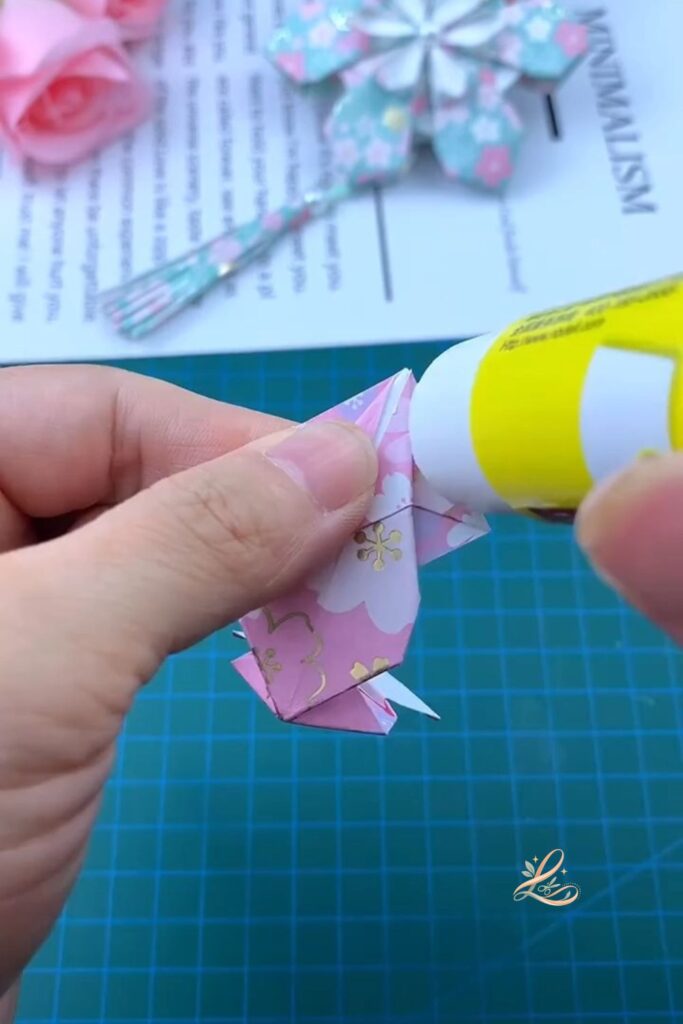
Pro Tip: Check your modules against each other as you go. If one looks noticeably wider or shorter than the others, set it aside and make a replacement. You only need six, but making a seventh spare module costs very little extra time and means you have one to swap in if a module does not sit right during assembly.
Step 8: Glue Two Modules Together
Apply a thin line of glue stick to the flat interior face of one petal module, then press a second module firmly against it so the two flat sides bond together. Hold the joined pair in your fingers for about 15 seconds, pressing gently from both sides, until the glue grips. When you release them, the two modules should sit side by side with their petals fanning outward, like the first two petals of your flower. This is the beginning of your assembly.
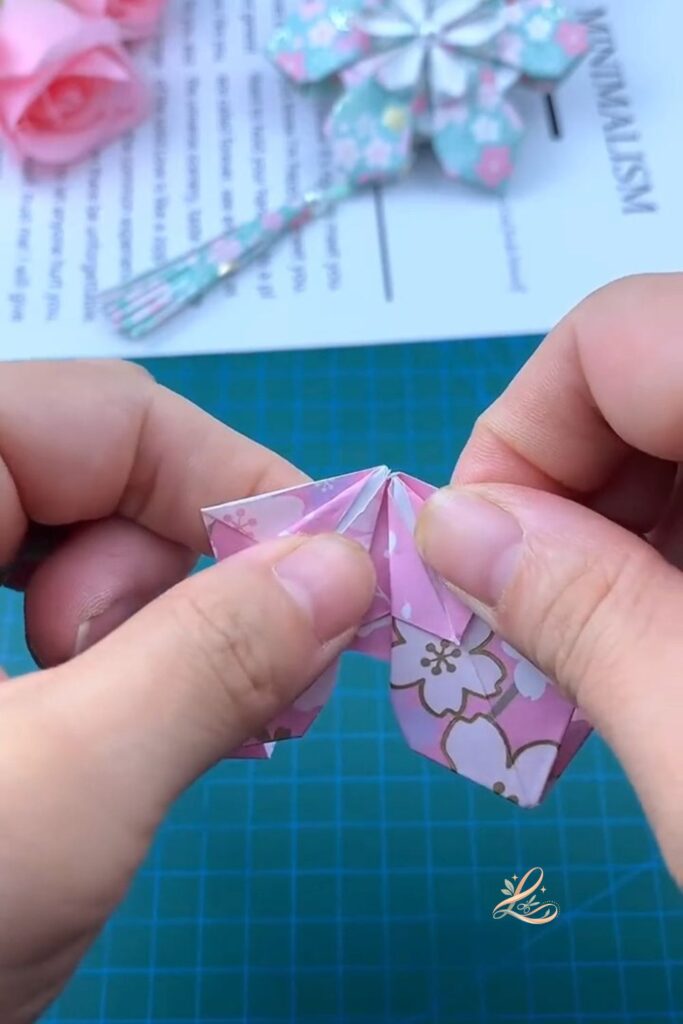
Pro Tip: Apply the glue slightly inside the edge of the flat face rather than right to the rim. This keeps any excess glue from squeezing out onto the patterned surface where it will show. A small amount of glue is enough, you do not need a heavy coat.
Step 9: Add the Remaining Four Modules One at a Time
Glue each remaining module to the growing flower in the same way, pressing each new module against the flat side of the previous one and holding firmly for 15 seconds before adding the next. Work your way around the circle, adding one module at a time. After the fourth module is added, you will see the flower shape starting to form. After the fifth and sixth modules are glued in, bring the two open ends together and press firmly the first and last modules to close the circle and complete the flower.
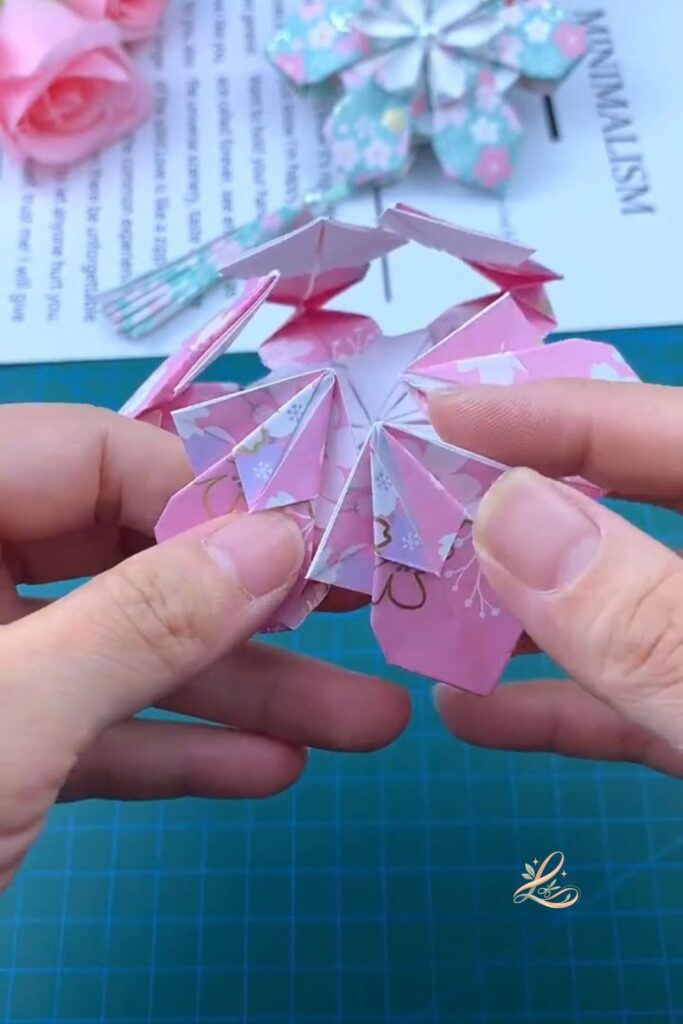
Pro Tip: Keep the bottom points all facing the same direction (downward) as you build the circle. It is easy to accidentally glue one module upside down when you are working quickly. Take a breath between each module and check the orientation before you apply any glue.
Step 10: Attach the Inner White Petal Layer
Take your white or light-coloured paper piece, fold and shape it into a smaller inner flower using the same petal module technique, and press the inner layer gently into the centre of your finished outer flower. The inner layer sits on top of the outer flower and adds depth and contrast, giving the finished piece that layered cherry blossom look. Apply a small amount of glue to the back of the inner layer before pressing it in place. Hold it steady for 30 seconds while the glue sets.
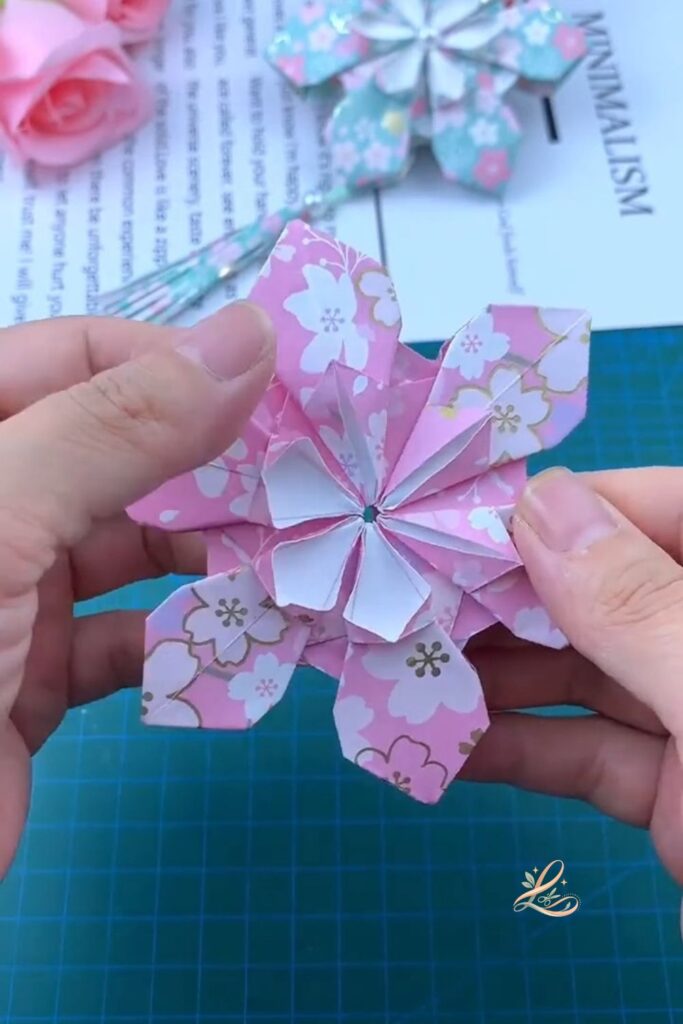
Pro Tip: Make the inner flower slightly smaller than the outer one so the outer petals frame it beautifully. If you fold the inner modules with a paper strip that is about two-thirds the width of your outer strip, the size difference will look perfect without any measuring.
Step 11: Push the Pearl Brad Through the Centre
Hold the layered flower face-up in one hand, then use your tweezers to push a pearl brad through the very centre point where all the petal modules meet. Spread the brad legs open on the back to lock it in place. The pearl should sit in the centre of the flower like a real cherry blossom stamen. Taking your time with the placement of the brad centre is the first thing the eye goes to in the finished piece, so getting it centred makes a big difference.
Pro Tip: If you do not have a brad, add a small dot of craft glue to the centre and press a flatback pearl gem or a button on top. Leave it to dry flat for five minutes before you hang the ornament. The result looks just as polished.
Step 12: Attach the Ribbon Loop and Tassel to Finish
Thread a 20 cm piece of white ribbon through the top of the flower between two petal modules, then tie a knot to form a hanging loop. On the other end of the ribbon (running through the bottom of the flower), thread on a small paper cherry blossom charm or sticker charm, then tie a pink paper tassel to the very end. Adjust the lengths so the tassel hangs about 8 to 10 cm below the flower body. Your ornament is finished and ready to hang.
Pro Tip: If you do not have a pre-made tassel, cut a small rectangle of patterned paper, make fringe cuts along one long edge leaving about 1 cm uncut at the top, then roll and glue the uncut edge tightly. This creates a quick handmade tassel in minutes and it looks beautiful.
Tips and Tricks
Use double-sided patterned paper where you can. The video uses paper that has a pattern on one side and a coordinating plain or lighter colour on the other. When you open the 3D modules, that contrast between the outer patterned face and the inner plain face adds a gorgeous depth to the flower. Solid-colour origami paper also works, but two-toned paper gives a much richer result.
Crease every fold twice. Run your fingernail firmly along each fold line twice rather than once. Paper that is double-creased stays crisp and flat, which makes the modules easier to glue together accurately and gives the finished flower cleaner edges. This single habit will noticeably improve your results from the very first module.
Work on a hard, flat surface. A cutting mat or a hardback book works better than a soft surface like a sofa or bed for this project. Firm pressure during folding and pressing is what makes the creases sharp, and you can only apply firm pressure if the surface underneath does not give way.
Let each glue joint dry before stressing it. When you glue modules together, hold each joint for a full 15 seconds and then set the partial flower down while you prepare the next module. Rushing the assembly by adding modules before the previous join has gripped is the most common reason for a flower that falls apart. Take your time at every stage.
Store finished ornaments hanging, not lying flat. Once the flower is complete, hanging it is the best way to keep its 3D shape intact. If you lay it face-down, the petals can flatten and lose their gentle curve. A hook inside a wardrobe door or a small nail in the wall works perfectly as a storage spot.
Ways to Use This Craft
As Home Decor
Hang a cluster of three paper sakura ornaments in your window using varying lengths of ribbon for a delicate, airy window display. They suit Japandi, cottagecore, and modern minimalist interiors equally well. Grouped in a glass cloche or laid in a shallow dish, they also make a lovely centrepiece for a dining table.
As a Gift
A handmade paper sakura ornament is a beautiful gift for Mother’s Day, Valentine’s Day, or a birthday. Pair it with a small handwritten note and tuck it into a gift box. Anyone who loves flowers, Japanese aesthetics, or handmade things will absolutely treasure this.
As Garden or Outdoor Decor
Hung from a tree branch on a calm day, as shown in the video, the sakura ornament creates a magical outdoor display. It is not weatherproof for long-term outdoor use, but for a garden party, an outdoor photo shoot, or a spring celebration, a row of these hanging from a branch is genuinely stunning.
Seasonal Variation
Use red and gold patterned paper and a gold brad centre to make a Chinese New Year version. Swap to orange and yellow for an autumn leaf aesthetic. Use white and silver paper for a winter or wedding version. The folding technique is the same for all of these, only the paper changes.
Read more: Adorable DIY Paper Gift Box Perfect for Beginners
Frequently Asked Questions
Q: How long does it take to make a paper sakura flower ornament like this? A: Your first ornament will take around 30 to 45 minutes as you get used to the folding steps. Once you have made one and the module fold is in your muscle memory, each ornament after that takes closer to 15 to 20 minutes. Making a set of three for a window display takes most people under an hour.
Q: What if my modules do not all look the same when I finish folding them? A: This is completely normal, especially on your first attempt. Small differences in module size come from tiny variations in how you cut the paper strips. Try to cut all strips at once using a single strip as your measurement guide, and the consistency will improve a lot. It is okay if they are not identical; the overlapping petals hide small variations beautifully once the flower is assembled.
Q: Where can I buy the patterned origami paper used in this video? A: Patterned origami paper is widely available at craft stores, Japanese stationery shops, online craft retailers, and dollar stores. Look for double-sided paper where one side is a floral pattern and the other is a complementary plain colour. If you cannot find sakura or cherry blossom prints specifically, any delicate floral print in pink or white tones will give a very similar result.
Q: Do I need to use a brad for the centre or can I use something else? A: You do not need a brad at all. A flatback pearl gem glued in place with a dot of craft glue looks just as beautiful and is easier to attach. You can also use a button, a sequin, a small sticker, or even a circle punched from contrasting paper. The centre embellishment is entirely up to you; it is the last step and completely customisable.
You Did It!
You have just folded six individual petal modules and assembled them into a genuine paper cherry blossom, and that is a real creative achievement. These ornaments are the kind of thing you will want to make again and again in different papers and colours, and the people you give them to will keep them for years.
Share your creation with us. We would love to see it! Ready for your next project? Try Easy Paper Envelope Craft Perfect for Beginners next!
Happy crafting! LOUVADECORES