

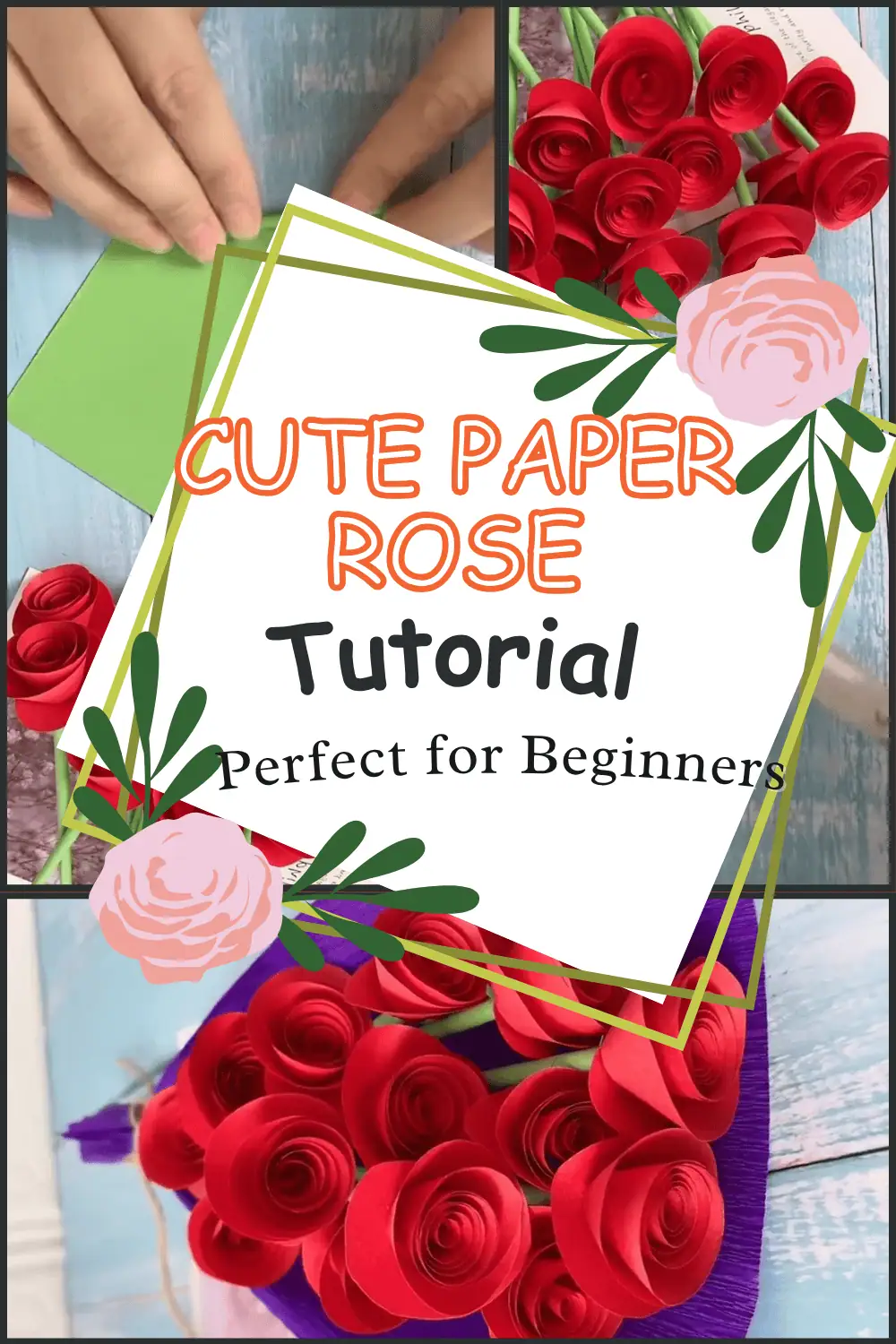
Imagine a bouquet of deep red roses sitting on your kitchen table full, lush, and absolutely beautiful. Now imagine you made every single one yourself, for less than the price of a coffee. That is exactly what you are going to have by the end of this tutorial.
You do not need any experience with paper crafts. You do not need any special tools. By the time you finish reading this post and watching the video, you will know exactly how to make your own spiral paper roses and then a whole bouquet of them.
For this project you will need red cardstock, green cardstock or paper, scissors, a glue stick or craft glue, wooden skewers or wire stems, and crepe paper for wrapping your bouquet. Each rose takes about 5–10 minutes once you have practised the technique once or twice.
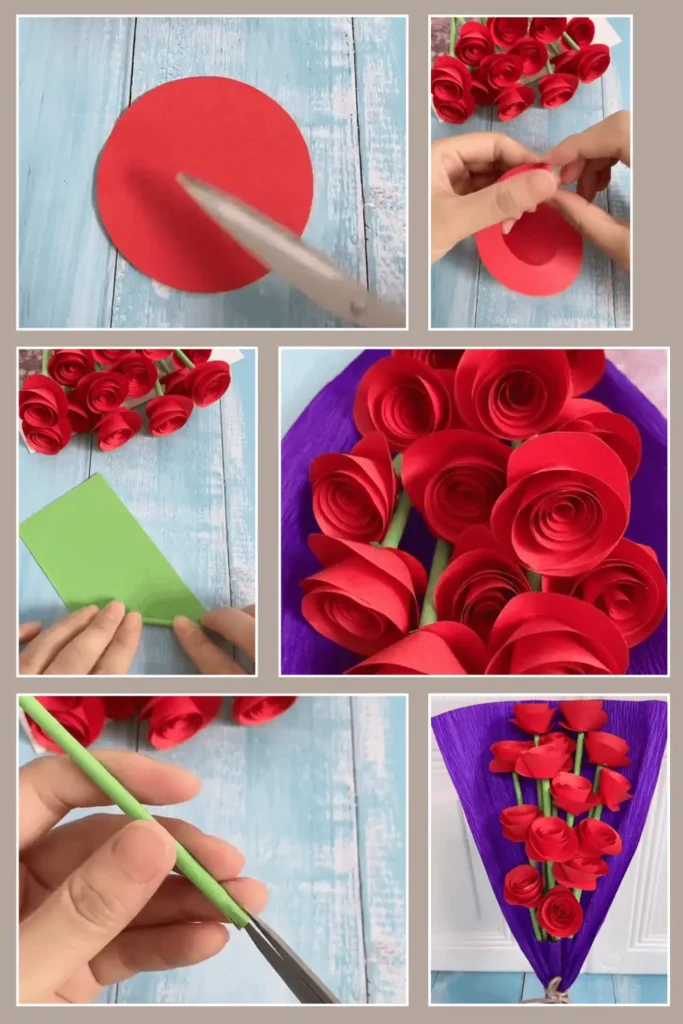
Why You Will Love This Project
These spiral paper roses look so realistic that people genuinely ask if they are real flowers. They cost almost nothing to make a full bouquet of a dozen roses that can be made for under $3 in materials. Unlike real flowers, your handmade roses will last forever, making them an incredible keepsake gift or a permanent piece of home decor. The video is short, the technique is satisfying to learn, and once you make one rose, you will not be able to stop.
What You Will Need
- Red cardstock [or any thick coloured paper, such as construction paper]
- Green cardstock [or green craft paper, even wrapping paper works]
- Scissors [any household scissors will do the job]
- Craft glue or a glue gun [a glue stick works for the rose; a hot glue gun is best for attaching the stem]
- Wooden skewers or floral wire [wooden chopsticks or thin dowel rods also work]
- Crepe paper in a bold colour [tissue paper or wrapping paper makes a fine substitute]
- Twine or ribbon [for tying your bouquet]
Total estimated cost: $2–$5 All materials can be found at your local craft store or ordered online.
Video Tutorial
Watch the full tutorial above before reading the written steps. The written steps below match the video exactly so you can follow along at your own pace.
Step-by-Step Instructions
Step 1: Draw and Cut Your Spiral Circle
Take a piece of red cardstock and draw a large circle roughly the size of your palm or slightly bigger. Inside that circle, draw a continuous spiral line from the outer edge all the way toward the centre. Leave a small round disc in the very centre this will be the base of your rose. Now cut along the spiral line from the outside edge inward, keeping your scissors as steady as you can. Take your time with this the cut does not need to be perfectly smooth.
At the end of this step, you should have one long continuous spiral strip of red paper still attached to a small round disc at the centre.
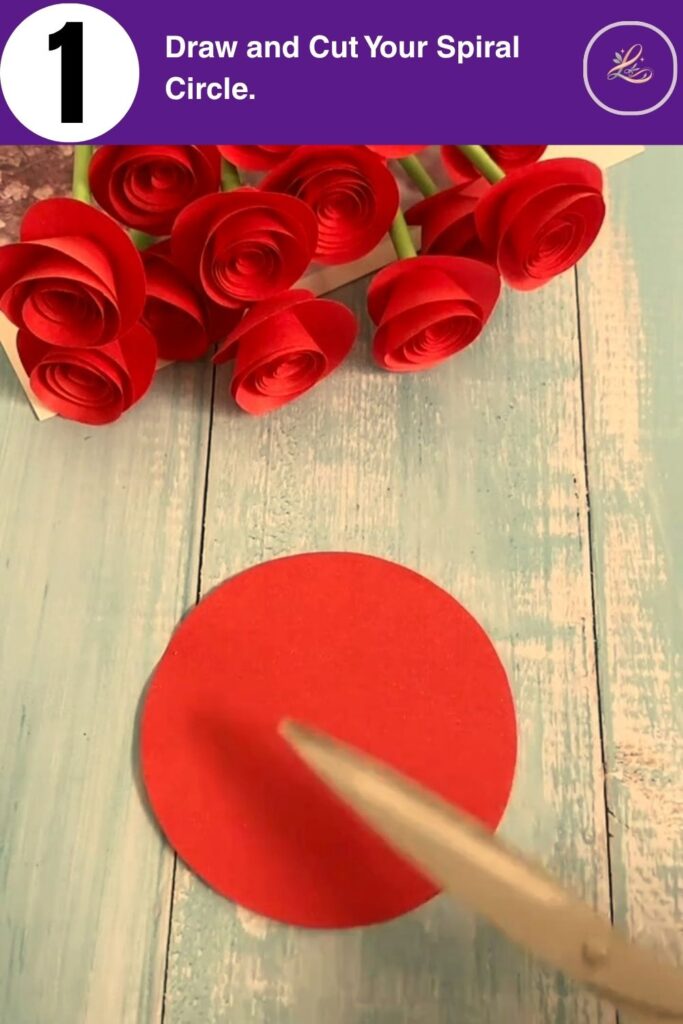
Pro Tip: Draw your spiral lightly in pencil before cutting a little, planning here makes the cutting much easier and gives you a more even petal shape.
Step 2: Begin Rolling the Spiral Strip
Pick up the outer end of your spiral strip the very tip and start rolling it tightly toward the centre. Use your fingers to coil the paper inward, keeping the roll firm and even as you go. Do not worry if it feels awkward at first. Your fingers will find their rhythm within the first few rolls.
By the end of this step, you will have a tight coil forming in your hand and most of the spiral strip will be rolled up.
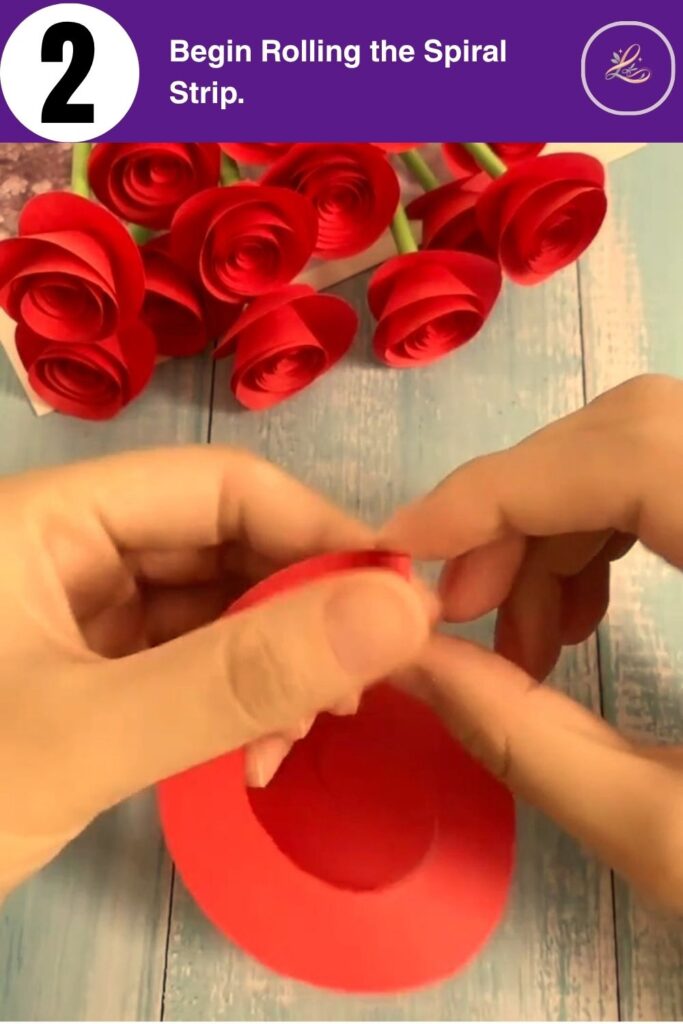
Pro Tip: Roll from the very tip of the spiral strip, not from the middle. Starting at the tip gives your rose a defined centre that looks much more realistic.
Step 3: Continue Rolling Toward the Base Disc
Keep rolling the spiral strip all the way to the small round disc at the centre. Hold the coil gently but firmly so it does not spring back open. As you reach the base disc, let the coil relax very slightly; it will open up naturally into a beautiful rose shape. It is okay if it is not perfectly round. No real rose is perfectly symmetrical either.
At this point, you will be holding a fully formed rose head; the coil will have bloomed open into layered petals.
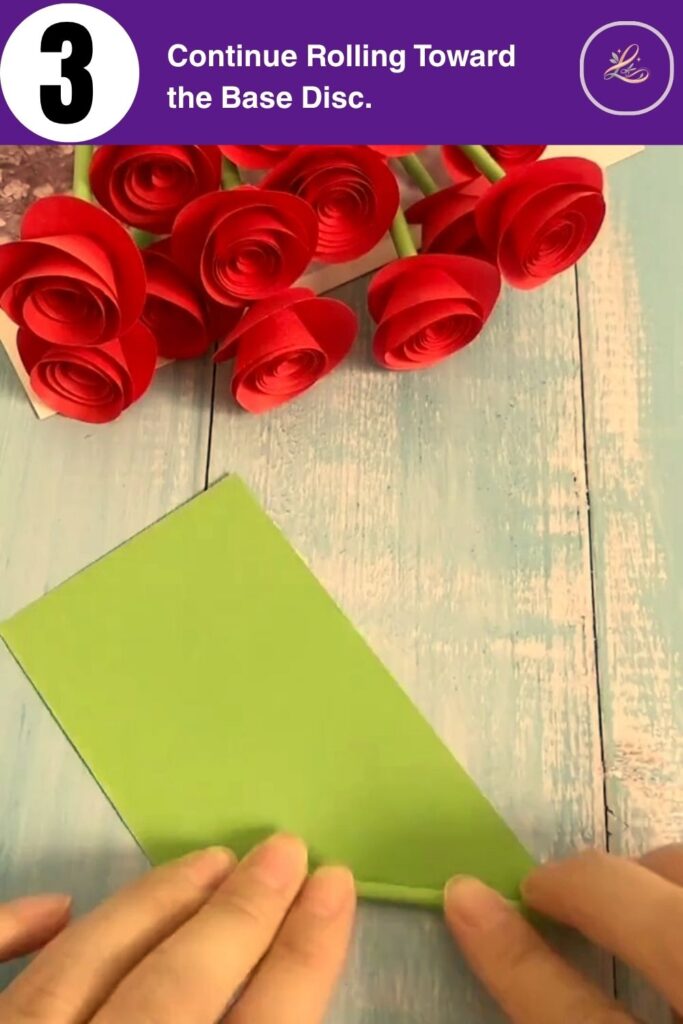
Pro Tip: The looser you hold the coil as it relaxes, the more open and full your rose will look. If you want a tight, bud-style rose, hold it a little firmer as you release.
Step 4: Glue the Base and Set the Rose Shape
Apply a small amount of glue to the flat base disc and press the bottom of your rose coil onto it to hold the shape. Hold it gently in place for about 20–30 seconds until the glue sets. This is the step that locks your rose into its beautiful open shape permanently. Without gluing the base, the coil will spring apart.
After this step, you will have a fully formed, free-standing paper rose head that holds its shape on its own.
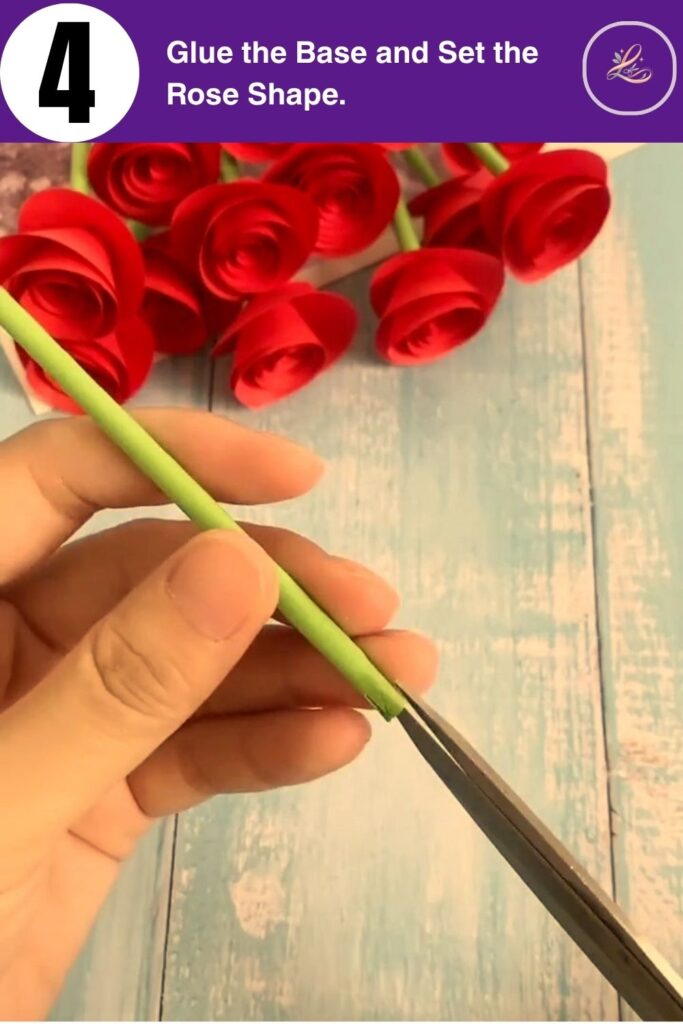
Pro Tip: Do not use too much glue here; a small dot in the centre of the base disc is all you need. Too much glue will seep through and make the petals stick together.
Step 5: Cut and Wrap the Green Paper Stem
Take your green cardstock and cut a long, thin diagonal strip roughly 1 cm wide. Place a wooden skewer or wire stem at one end of the green strip and begin wrapping the paper around the skewer at an angle, working your way down the length of it. Keep the wrapping tight and even as you go. A tiny dot of glue at the start and end of your strip will keep everything secure.
At the end of this step, you will have a neat green stem that looks just like a real flower stem.
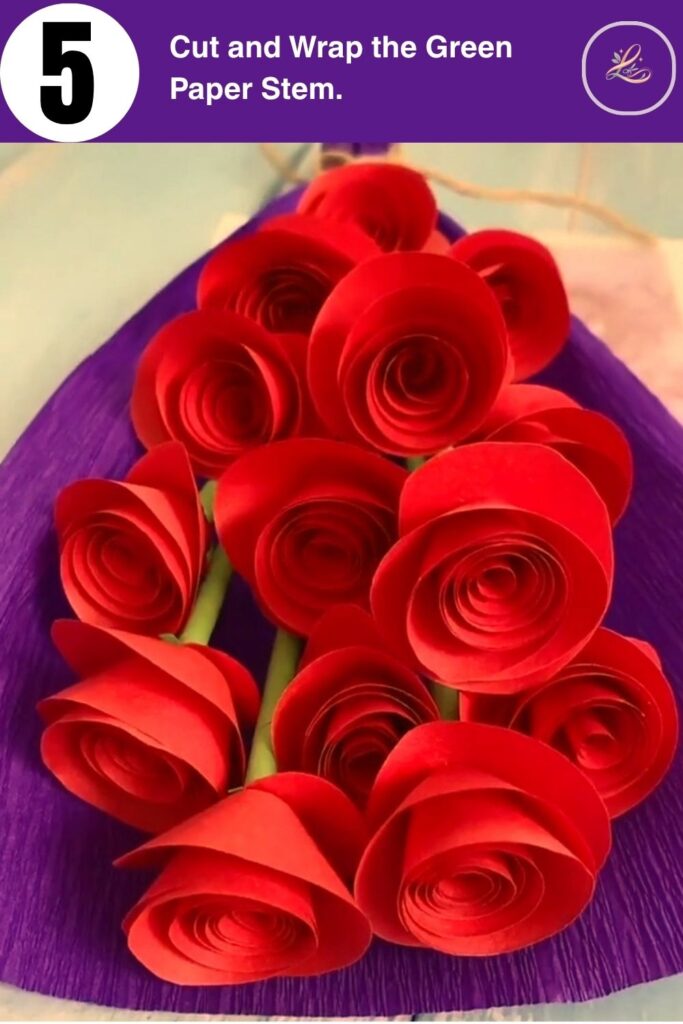
Pro Tip: Cut your green strip on a diagonal rather than straight across wrapping a diagonal strip around a stem gives a much neater, less bumpy finish than a straight-cut strip.
Step 6: Attach the Rose Head to the Stem
Apply a small amount of glue to the top of your green stem and press the base of your rose head firmly onto it. Hold it in place for 30 seconds or so. Make sure the rose head sits straight and upright on the stem before the glue fully sets; you can adjust the angle slightly while the glue is still warm or wet. Once set, your rose is complete.
After this step, you will be holding a fully finished paper rose stem, petals, and all.
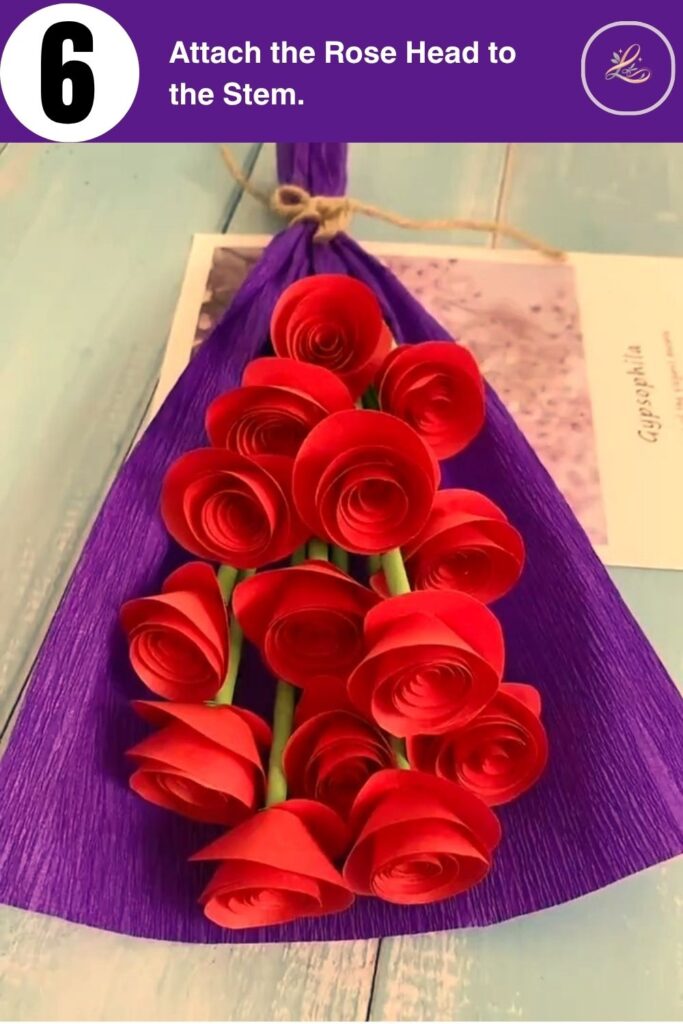
Pro Tip: If you want to add a small leaf to your stem, cut a simple leaf shape from green cardstock and glue it onto the stem about halfway down. It adds a lovely realistic touch with almost no extra effort.
- Easy DIY 3D Origami Christmas Tree (Cute Folded Holiday Decor)
- Easy DIY Origami Cruise Ship (5-Minute Paper Boat Tutorial)
- Easy DIY 3D Paper Heart Hot Air Balloon (5-Minute Kids Craft & Gift Card)
- Easy DIY 3D Pop-Up Flower Card (Exploding Floral Bouquet Tutorial)
- Easy DIY Paper Sunflower Card (With Surprise Flip Message!)
Step 7: Arrange and Wrap Your Bouquet
Once you have made a full set of roses, gather them together in one hand and arrange them at slightly different heights for a natural, bouquet feel. Lay a large sheet of crepe paper on your surface, place your rose bundle in the centre, and fold the crepe paper up around the stems. Secure the whole bundle at the base with a length of twine or ribbon, tying it into a simple bow.
Your finished bouquet will look like something from a florist lush, full, and completely handmade.
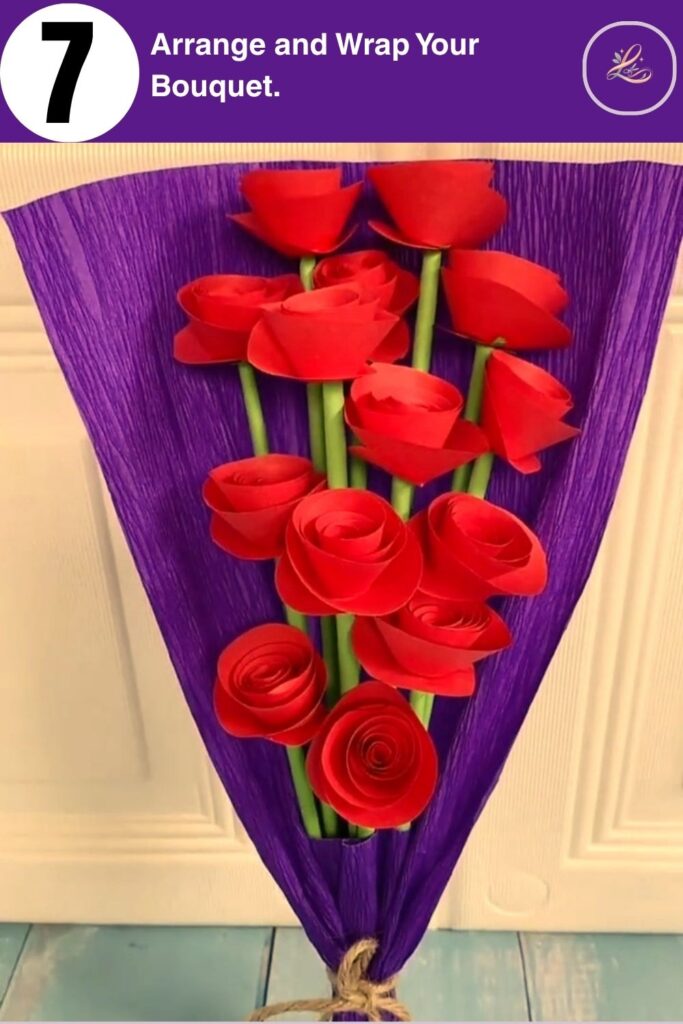
Pro Tip: Vary the tightness of a few roses when you make them mix some tighter buds with more open blooms. A mix of bud and open rose shapes makes the bouquet look much more lifelike and professional.
Tips & Tricks
Use a coin to draw your circle. A compass is not needed tracing around a jar lid, a glass, or a large coin gives you a perfect circle every time. Consistency in your circle size means all your roses will turn out roughly the same size, which makes for a neater bouquet.
Cardstock weight matters more than you might think. Paper that is too thin will give you floppy, limp petals that do not hold their shape well. Paper that is too thick will be hard to roll and may crack. Standard 160–200gsm cardstock is the sweet spot. It holds its shape beautifully without fighting you when you roll.
If your rose springs apart before you glue it, do not panic. Gently re-roll it and apply the glue a little faster this time. You can also hold the coil in your closed fist for a moment to encourage it back into shape the warmth from your hand helps the paper stay curled.
Store your finished roses away from humidity. Paper roses are not happy in damp or humid rooms. If you are displaying them in a bathroom or near a kitchen sink, a very light spray of hairspray on the finished roses will protect the paper and keep the petals from softening.
Make your roses in batches of five. Cutting five spirals at once before you start rolling keeps your workflow efficient. It also means you start to see your bouquet taking shape faster, which is very motivating when you are learning a new craft technique.
Ways to Use This Paper Rose Tutorial
As home decor: A bouquet of red paper roses looks stunning on a console table, a bedroom dresser, or as a centrepiece on a dining table. Because the colours never fade, these roses suit any interior style from modern minimalist to romantic cottage and they will look just as beautiful in six months as they do on the day you make them.
As a gift: This bouquet makes an incredibly heartfelt gift for Valentine’s Day, Mother’s Day, anniversaries, or birthdays. Unlike real flowers, a paper rose bouquet is something the recipient can keep forever. Present it in a simple vase with a handwritten note and it becomes a truly memorable, personal gift that money cannot quite replicate.
For seasonal variations: Red roses are classic for Valentine’s Day and anniversaries, but swap your cardstock colour for soft pinks and whites for a spring or Mother’s Day bouquet, deep burgundy and orange for autumn, or glittery gold and silver cardstock for Christmas and New Year celebrations. The same technique, a completely different look.
Frequently Asked Questions
-
How long does it take to make a paper rose bouquet like this?
A: Each individual rose takes about 5–10 minutes once you have practised the rolling technique once or twice. A bouquet of a dozen roses will take most people around 1.5 to 2 hours in total. No rush you can make the roses in stages and bring the bouquet together whenever you are ready.
-
What if my rose does not turn out perfectly can I fix it?
A: Absolutely. If your coil springs open before you glue it, simply re-roll it and apply the glue a little more quickly this time. If the rose head looks uneven, gently press the petals into shape with your fingers before the glue fully sets. There is no such thing as a ruined paper rose; every variation just makes it look more like a real one.
-
Where can I buy the materials for this project?
A: Red and green cardstock is available at most craft stores such as Hobbycraft, Michaels, or Daiso, as well as online through Amazon or Etsy. Wooden skewers can be found in any supermarket or dollar store, usually in the kitchen or baking section. You likely already have scissors and glue at home.
-
Does the spiral need to be a perfect shape for the rose to look good?
A: Not at all. A slightly wobbly or uneven spiral will actually produce a rose with more character and natural-looking petals. Real roses are not perfectly uniform either. Focus on keeping the spiral roughly the same width all the way around, and the result will be beautiful imperfections and all.
You Did Something Beautiful Today
You now know how to make a paper rose that looks like it came from a florist and you made it with your own hands. That is genuinely something to be proud of. Share your creation with us. We would love to see it! Tag us or drop your photo in the comments below so we can celebrate your work with you.
Ready for your next project? Try Pop-Up Paper Flower Card Tutorial for Beginners next!
Happy crafting! LOUVADECORES
Follow us on: Pinterest

One thought on “Spiral Paper Rose Tutorial Perfect for Beginners”