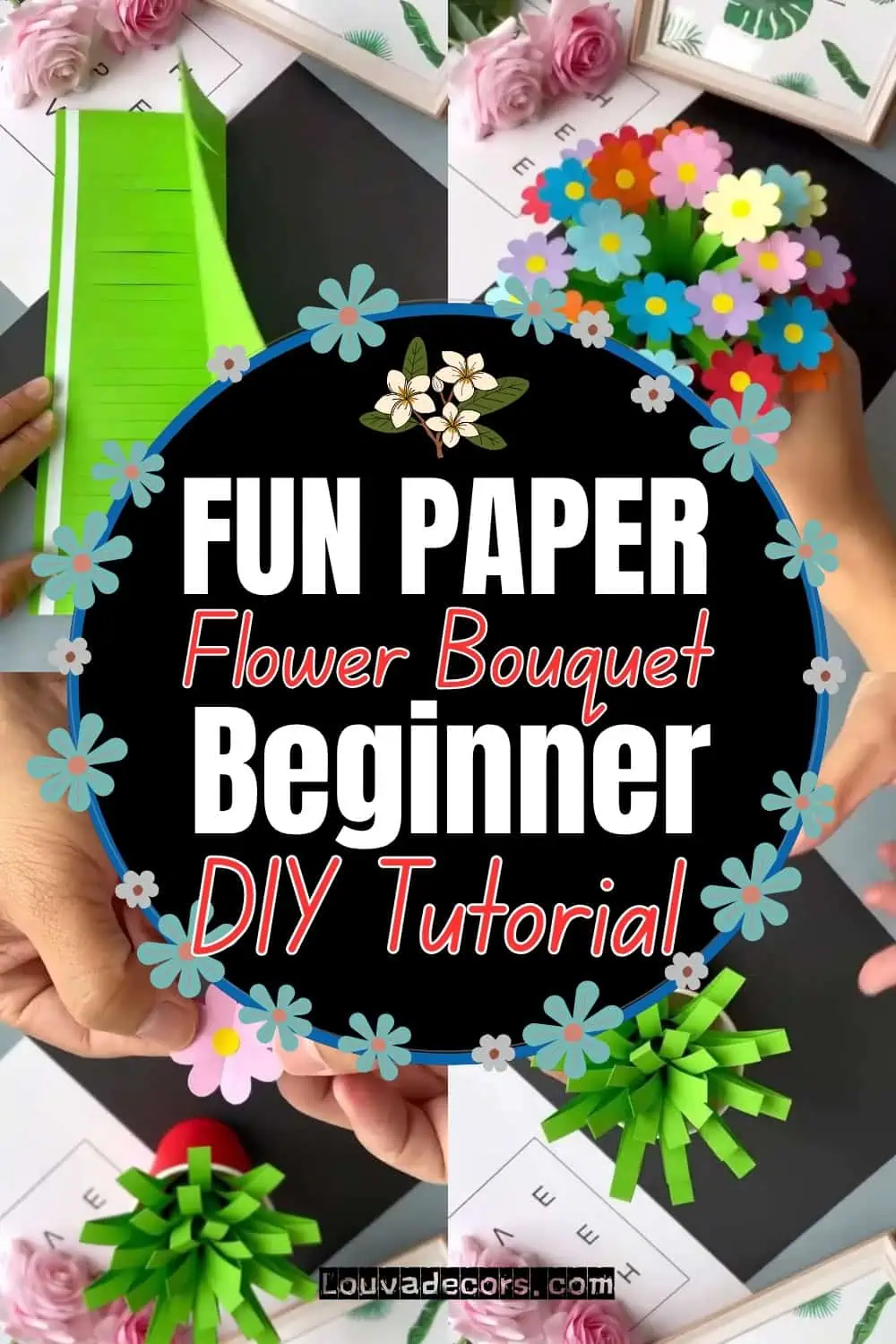

Picture a little pot absolutely overflowing with paper daisies pink, blue, purple, orange, red, yellow every colour you love, all fanning outward in one full, lush bouquet. It looks like something from a boutique gift shop. You made every single piece of it yourself, out of cardstock and scissors.
You do not need any experience to make this paper flower bouquet. You do not need a craft room, a special cutting machine, or tools you have never heard of. By the end of this post, you will have a complete, colourful bouquet sitting in its very own pot ready to display on a shelf, give as a gift, or keep on your desk forever.
All you need is coloured cardstock, scissors, glue, and a small pot or cup. Most people finish this project in 30–45 minutes.
WHY YOU WILL LOVE THIS PROJECT
This paper flower bouquet in a pot is one of those rare crafts that looks incredibly impressive for how little effort and money it actually takes. The whole project costs just a few dollars in materials, yet the finished result genuinely looks like a designer piece. It makes a beautiful gift for almost any occasion, and because the flowers are paper, they will never wilt or fade. A full video tutorial is included right here in this post, so you are never left guessing what to do next.
WHAT YOU WILL NEED
- Green cardstock (A4 or letter size, 2 sheets) [or use green construction paper]
- Coloured cardstock in multiple colours: pink, blue, purple, orange, red, yellow, cream [or use coloured printer paper]
- Yellow cardstock or yellow foam sheet (for flower centres) [or use yellow sticky notes]
- Scissors [or use any craft scissors you already own]
- Ruler [or use the straight edge of a hardcover book]
- Pencil or pen (for marking lines and drawing petal guides) [any pen you have works fine]
- Glue stick or craft glue [or use a glue pen from any stationery shop]
- A small pot, paper cup, or plastic cup [the video uses a small white paper cup wrapped in red paper]
Total estimated cost: $3–$8 All materials can be found at your local craft store or ordered online.
VIDEO TUTORIAL
Watch the full tutorial above before reading the written steps. The written steps below match the video exactly so you can follow along at your own pace.
STEP-BY-STEP INSTRUCTIONS
Step 1: Mark Your Green Paper with Horizontal Lines
Take a sheet of green cardstock and lay it flat in portrait orientation tall, not wide. Use your ruler and pencil to draw a series of horizontal lines across the paper, spaced roughly 5–7mm apart. Stop your lines about 2cm from the top of the sheet that top strip must stay uncut, as it holds everything together. These lines are your cutting guides for the stem strips.
Take your time drawing the lines. They do not need to be perfectly even, and that is okay slight variation will only make your bouquet look more natural.
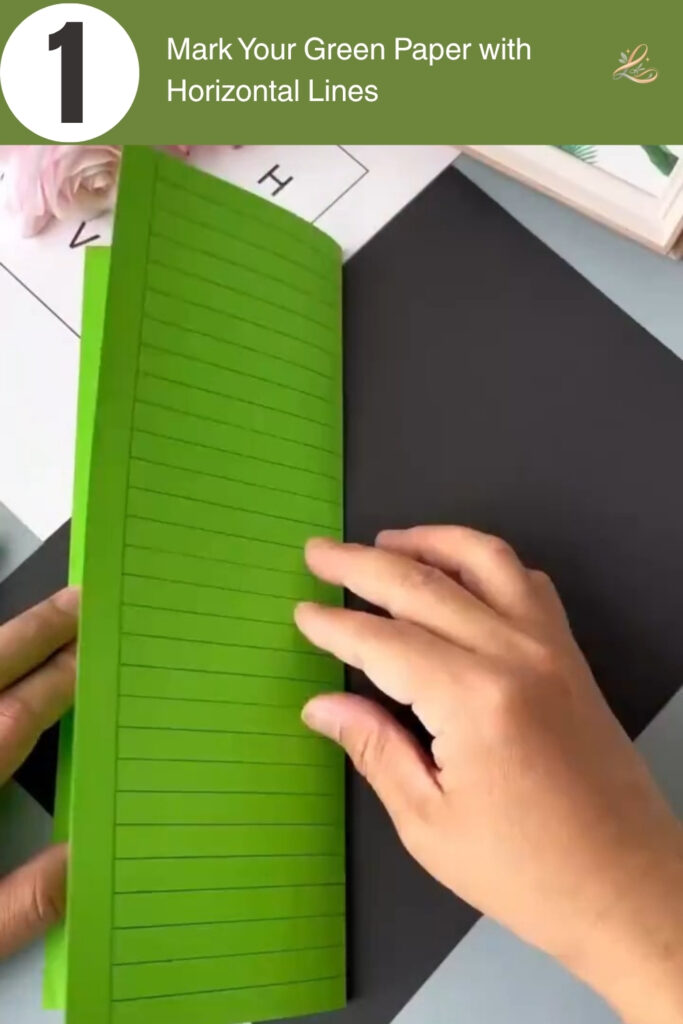
Pro Tip: Draw in light pencil so the lines do not show on the finished piece. Work from top to bottom so your hand does not smudge lines you have already drawn.
Step 2: Cut Along Every Line to Create Stem Strips
Hold your scissors steady and cut along each marked line, working from the bottom of the sheet upward toward the uncut top margin. Cut each strip one at a time, stopping cleanly before you reach that 2cm top border. When you have finished, your sheet should look like a wide green comb or fringe of many thin strips hanging from one solid top band.
Do not worry if a few strips are slightly different widths. Once the bouquet is assembled, no one will notice. What matters is that the top edge stays fully intact.
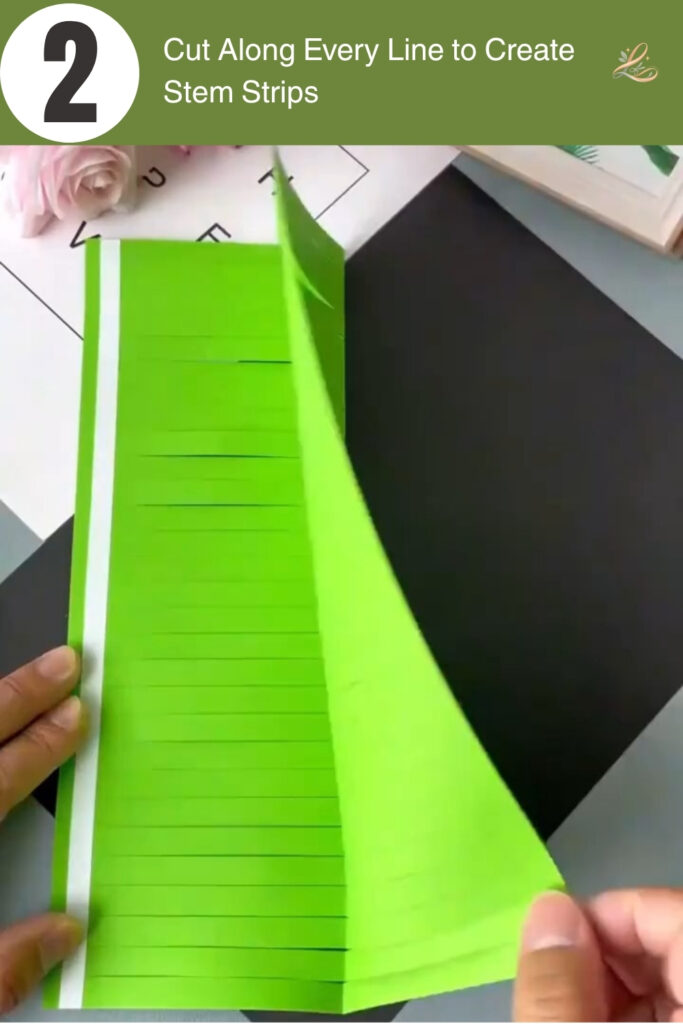
Pro Tip: Longer, slower scissor strokes give you straighter cuts than lots of short snips. Rest the paper flat on the table and cut from underneath if it helps you keep control.
Step 3: Roll the Fringed Paper into a Stem Bundle
Hold the fringed green sheet at its uncut top edge and begin rolling it tightly from one end toward the other, as if rolling a scroll. Keep the roll tight at the top where the paper is solid, and let the cut strips fan outward naturally at the bottom as you roll. Once fully rolled, you will have a compact cylinder of paper with a burst of green strips splaying out from the bottom; this is your bouquet base.
Hold the roll firmly for a moment. The strips will begin to settle into their fanned position on their own.
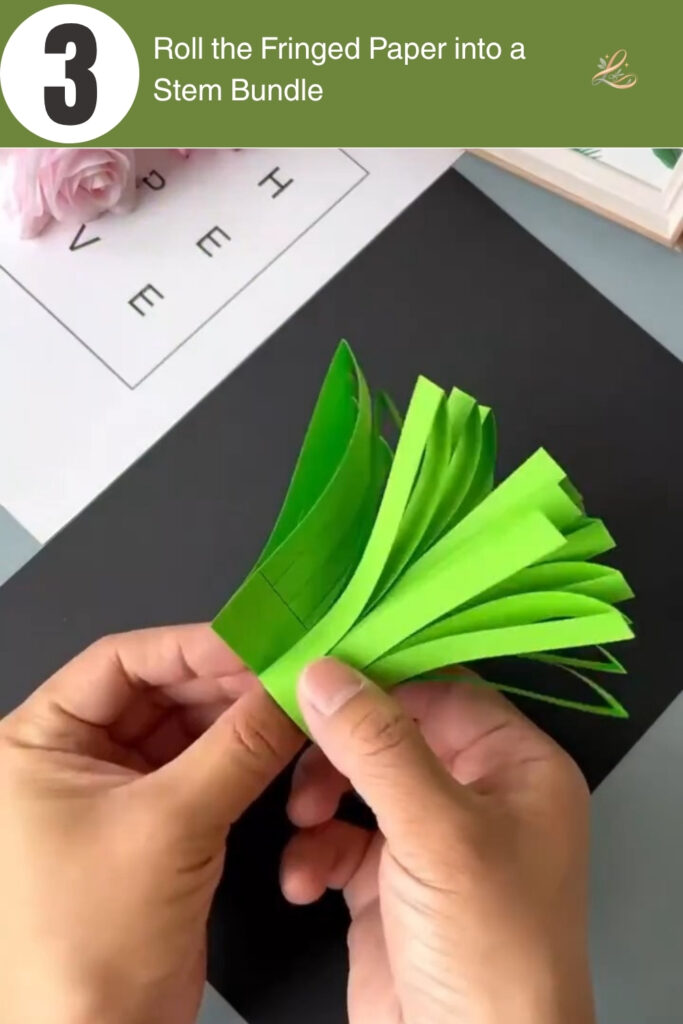
Pro Tip: The tighter you roll the solid top section, the neater your finished pot will look. If the roll feels like it wants to spring open, add a small strip of tape or a dab of glue to hold it closed before moving to the next step.
Step 4: Place the Stem Bundle Into Your Pot
Hold your small pot or cup in one hand and press the rolled green stem bundle down into it firmly. The uncut rolled section sits inside the pot and acts as the anchor, while the green strips fan outward over the rim in every direction. Add a dab of glue inside the pot if needed to hold the bundle securely in place.
Your pot should now look like a cheerful little plant a burst of green paper strips spreading out in all directions. This is the structure every flower will attach to.
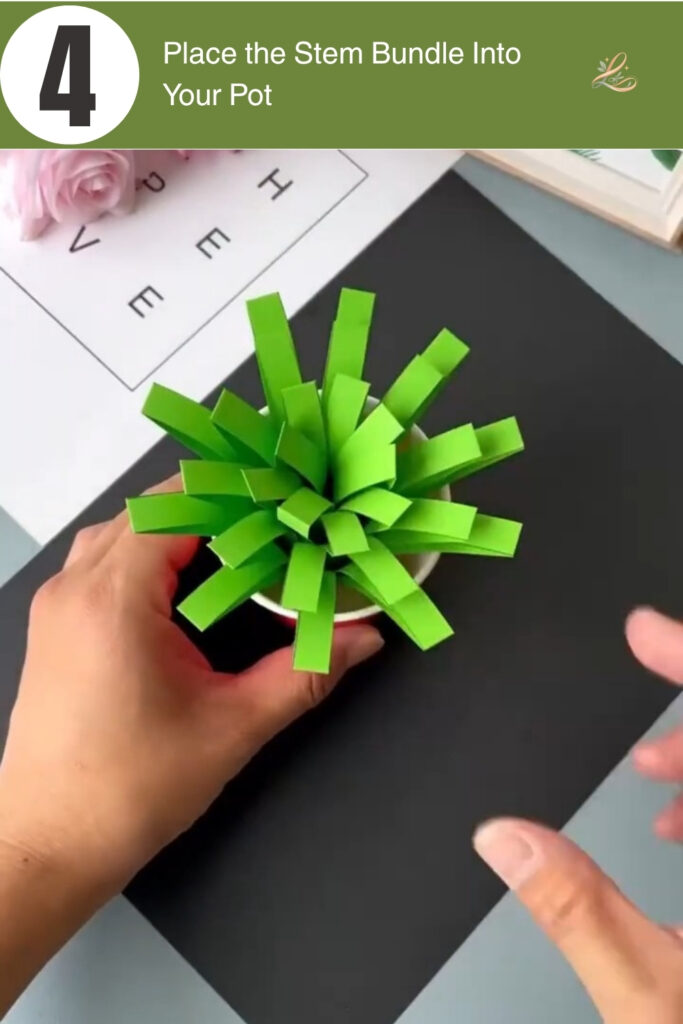
Pro Tip: If your pot is wider than the roll and the bundle feels loose, wrap a strip of spare paper around the base of the roll to bulk it up before inserting it. A snug fit means a sturdier bouquet.
Step 5: Fold a Square of Coloured Cardstock into a Triangle
Cut a small square of coloured cardstock approximately 5–6cm on each side then fold it in half diagonally to make a triangle. Fold it in half once more to make a smaller, thicker triangle. Press the fold flat with your fingernail so it holds its shape cleanly. This folded triangle is the starting point for every flower petal in your bouquet.
Repeat this step for as many flowers as you plan to make. The video bouquet uses around 15–20 flowers, so prepare that many folded triangles before moving on.
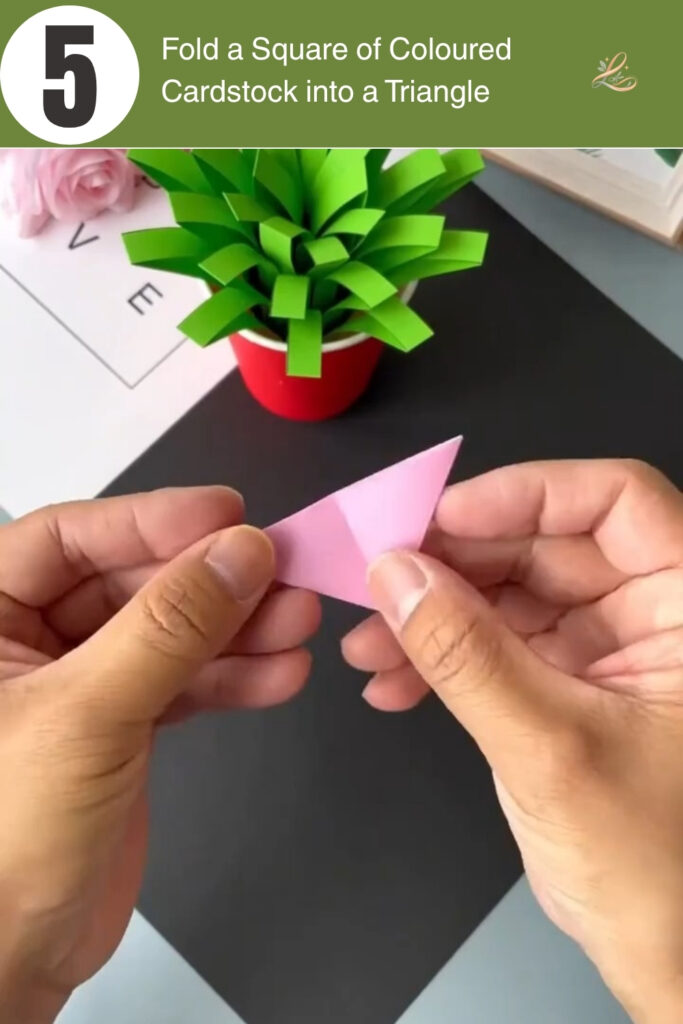
Pro Tip: Cut and fold all your squares in one go before you start cutting petals. Working in batches is much faster and keeps your workspace tidy.
Step 6: Draw and Cut the Petal Shape
Hold the folded triangle with the pointed tip facing up and the curved open edge facing down. Draw a small rounded bump along that open curved edge, think of drawing the top of a cloud or a single hill. Cut along the curve through all the layers of the folded paper. When you unfold, you will have a four-petalled flower shape. Repeat for every folded triangle you prepared.
It is okay if the petals are not perfectly symmetrical. Every handmade flower looks a little different, and that variety is what makes the finished bouquet feel warm and handcrafted rather than machine-made.
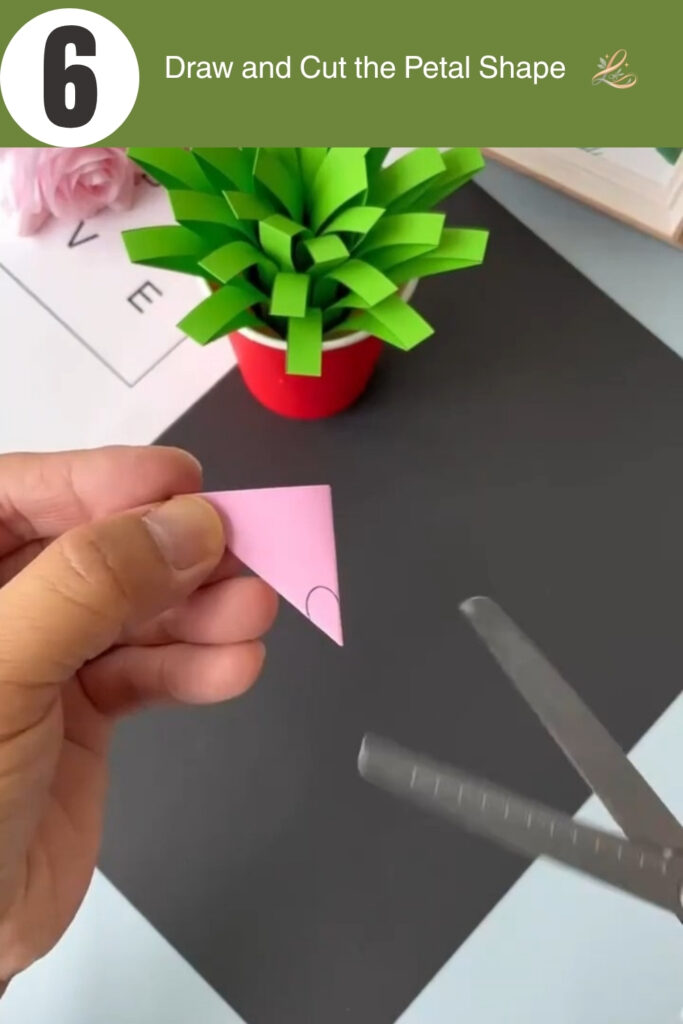
Pro Tip: The more rounded your curve, the rounder and fuller the petals will be. A sharp pointed curve gives more of a star shape. Either works beautifully it is entirely your choice.
Step 7: Shape the Flower by Overlapping the Petals
Once each flower is cut and unfolded, make one small snip from the base of each petal toward the centre about 5mm deep. Then overlap the two sides of that snip and secure them with a dab of glue, pressing firmly for a few seconds. This gives each petal a gentle three-dimensional curve, lifting it slightly so the flower looks rounded and full rather than flat.
Do this for all four petals on every flower before moving on to adding the centre. No rush let each glued overlap set properly before releasing it.
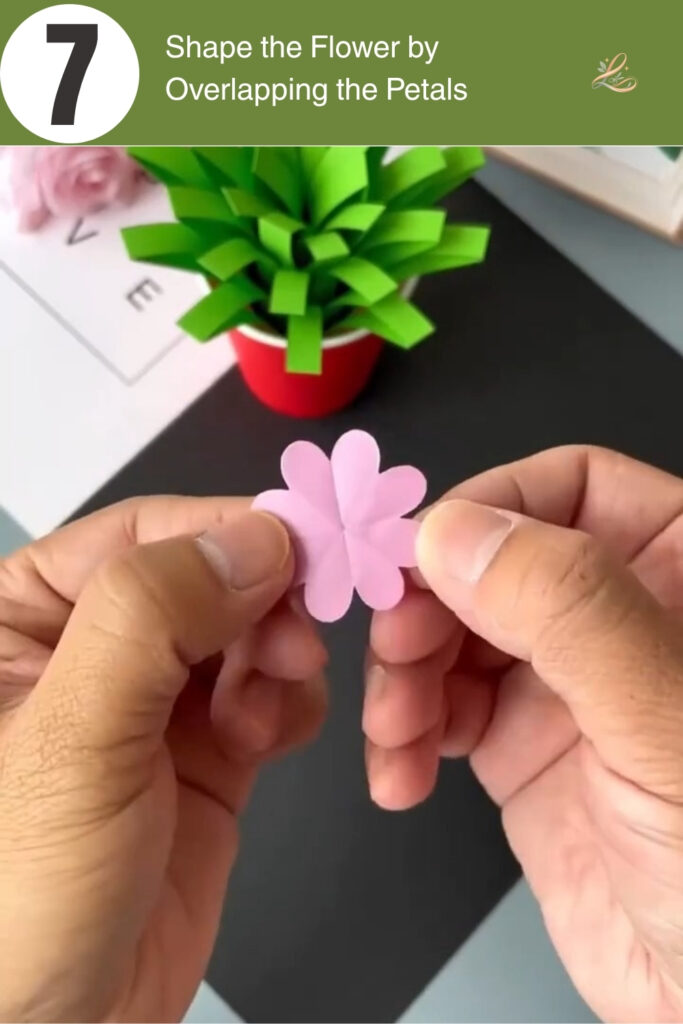
Pro Tip: Use a glue stick for this step rather than liquid glue. It is far less messy when working with small fiddly paper shapes and dries just quickly enough to keep things moving.
Step 8: Add the Yellow Centre
Cut a small circle from your yellow cardstock roughly 1cm across. Place a dab of glue in the very centre of your flower and press the yellow circle firmly on top. Hold it for a few seconds until it sticks. That one small yellow dot instantly transforms the paper shape into a cheerful, recognisable daisy. Make a yellow centre for every flower in your bouquet.
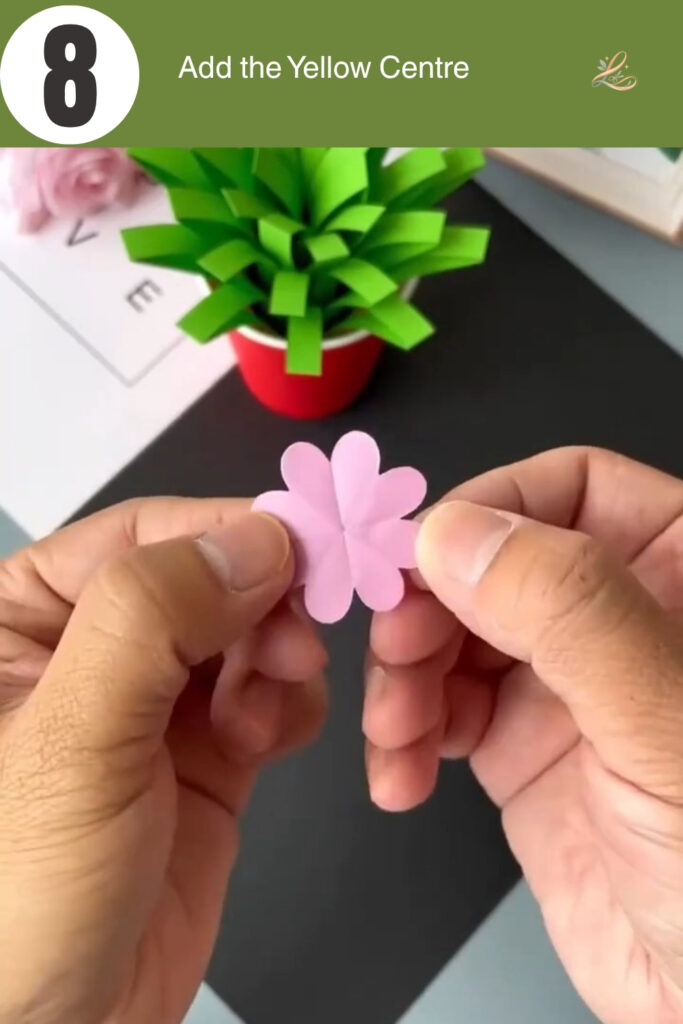
Pro Tip: A standard hole punch creates a near-perfect circle in one press and saves a lot of cutting time when you are making 15–20 flowers. If you do not have one, freehand circles cut with small scissors work perfectly well.
Step 9: Attach Each Flower to a Green Stem Strip
Take a completed flower and apply a dab of glue to its flat underside base. Press it firmly onto the tip of one of the green paper strips in your pot, holding it in place for a few seconds until the glue grips. Attach one flower per strip. Work your way around the pot, alternating colours as you go pink beside blue beside purple beside orange to build up a bright, joyful spread of colour.
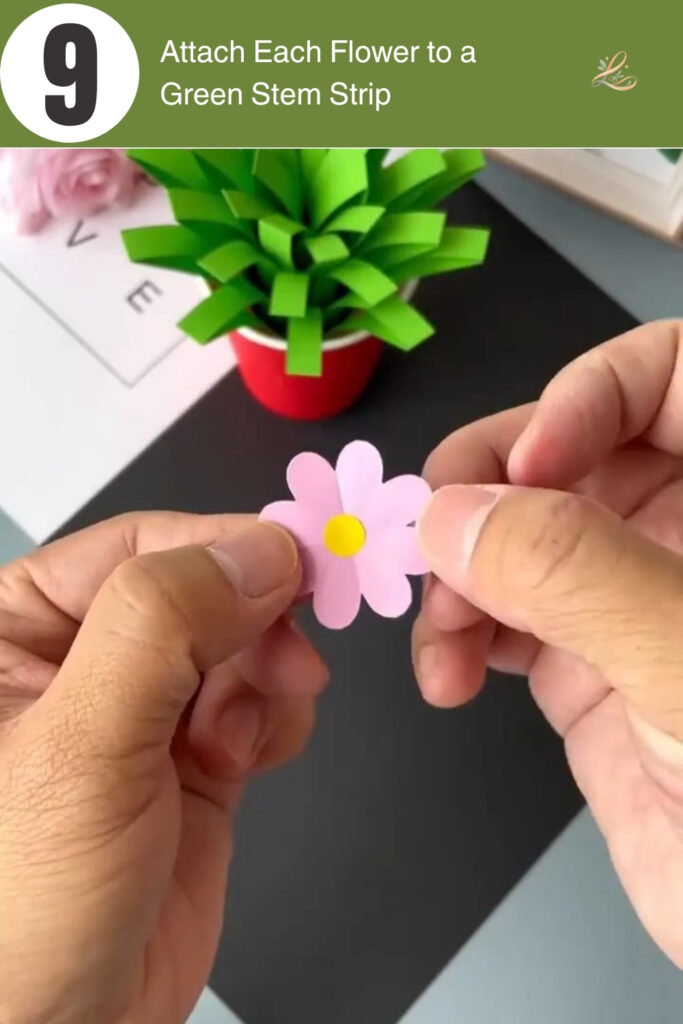
Pro Tip: Start by attaching flowers to the outermost strips first, then work inward. This gives you room to manoeuvre without accidentally knocking off flowers you have already glued.
Step 10: Fill the Bouquet and Finish
Continue attaching flowers to every remaining green strip until the whole bouquet is full. Step back and look at it from all angles. Gently bend any strips that need adjusting so the flowers spread evenly in every direction. If there are any gaps, add an extra flower. The bouquet is done when it looks full, rounded, and overflowing with colour exactly like the one in the video.
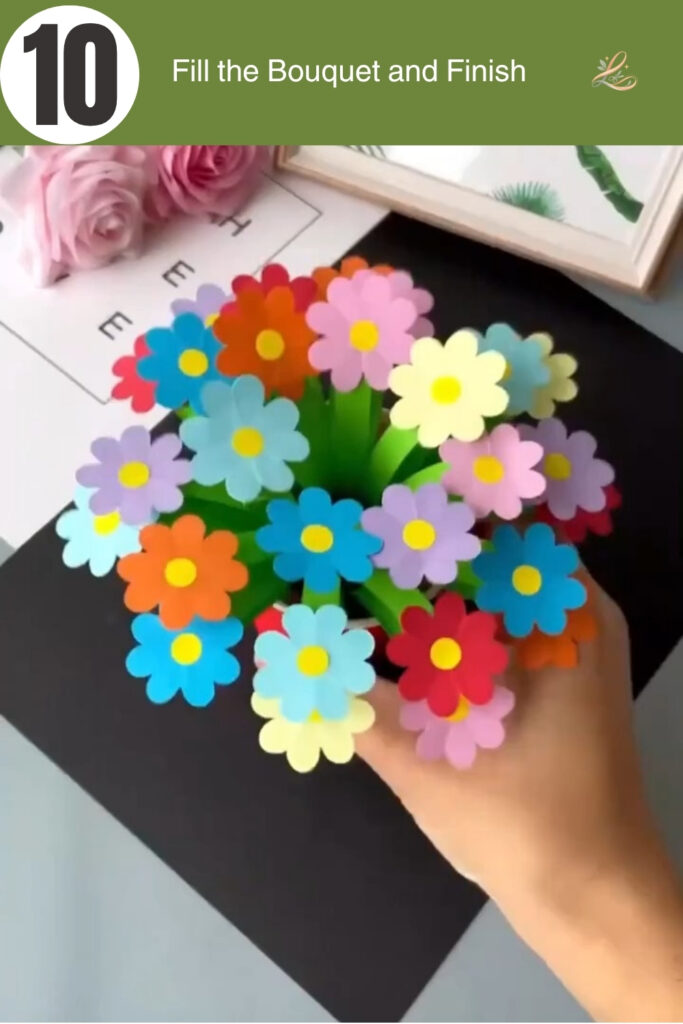
Pro Tip: Gently curve each green strip upward and outward after attaching the flower. This lifts the blooms away from the centre and gives the bouquet an open, natural shape rather than a flat-topped look.
[7] TIPS & TRICKS
Make all your flowers before you start assembling. It is tempting to attach each flower as you finish it, but making all 15–20 flowers first means you can step back and choose which colours go where before committing with glue. You will end up with a much more balanced colour spread across the whole bouquet.
If your green strips are curling upward too aggressively, ease them into shape by running each strip over the edge of a ruler. Hold the strip at one end, press your thumb against it, and pull it gently across the ruler’s edge. This softens the curl so you have more control over how each strip positions itself in the final arrangement.
Paper thickness matters more than you think. Standard 80gsm copy paper makes softer, more delicate flowers. Thicker 160gsm cardstock makes sturdier blooms that hold their shape very well. Try mixing both in the same bouquet; the slight variation in texture gives the arrangement a more organic, layered look.
If a flower comes unglued from its strip, do not panic. Apply a fresh dab of craft glue directly to the strip tip and hold the flower firmly in place for a full 10 seconds. Craft glue bonds more strongly than a glue stick for this particular join, so keep a small bottle nearby during the assembly step.
To display your bouquet beautifully, place it somewhere away from direct sunlight. Paper colours stay bright and vivid for a very long time in indirect light. A bookshelf, side table, windowsill out of direct sun, or bathroom counter are all perfect spots.
WAYS TO USE THIS CRAFT
As home decor, this paper flower bouquet in a pot suits almost every interior style modern, Scandi, eclectic, or maximalist. The bright rainbow palette pops against white walls and light wooden shelves. It works equally well on a coffee table, a desk, a bathroom shelf, or grouped with other small pots as a little paper garden display.
As a gift, this bouquet is a genuinely thoughtful present for anyone who loves flowers but does not want the responsibility of keeping live ones alive. It is perfect for birthdays, Mother’s Day, teacher appreciation gifts, get-well gestures, and housewarming presents. Wrap the pot in a square of tissue paper, tie with ribbon, and it looks completely professional.
For seasonal variations, swap your cardstock colours to suit the time of year. All white and gold for Christmas, soft pastels for Easter, deep red and burgundy for Valentine’s Day, or warm orange and rust tones for autumn. The same technique produces an entirely different feeling just by changing the colour palette.
FREQUENTLY ASKED QUESTIONS
-
How long does it take to make a paper flower bouquet in a pot?
A: Most beginners finish this project in 30 to 45 minutes. If you are making extra flowers to fill a larger pot, allow up to an hour. The more flowers you make, the faster you get by the tenth flower, folding and cutting feels very natural and quick.
-
What if my flowers do not look right the first time?
A: That is completely normal and happens to everyone. Your first flower will look different from your fifth, and your fifth will look different from your fifteenth; each one gets neater as your hands learn the folds. Keep every flower you make, even the wonky ones. Mixed into a full bouquet, no single flower draws attention and the overall effect is always beautiful.
-
Where can I buy the materials for this project?
A: Coloured cardstock, scissors, and glue are available at any craft store, stationery shop, or dollar store. You can also order everything online. The pot can be any small container you already have at home. A yoghurt pot, a paper cup, a small tin, or even a recycled candle jar all work perfectly.
-
Do I need to use a ruler to draw the lines on the green paper?
A: A ruler makes the lines straighter and the strips more even, which gives a neater finished bouquet. That said, you absolutely do not need a ruler freehand lines work too. The strips do not need to be perfectly even. Slight variation in width actually makes the bouquet look more natural and organic once everything is assembled.
CLOSING PARAGRAPH
Look at what you have just made a full, colourful paper flower bouquet that looks like it belongs in a gift shop, built entirely with your own hands from a few sheets of cardstock. That is genuinely something to be proud of. Share your creation with us. We would love to see it! Leave a photo in the comments below or tag us on Pinterest.
Ready for your next project? Try Cute Paper Flower Ornament With Tassel Beginner DIY next!
Happy crafting! LOUVADECORES