

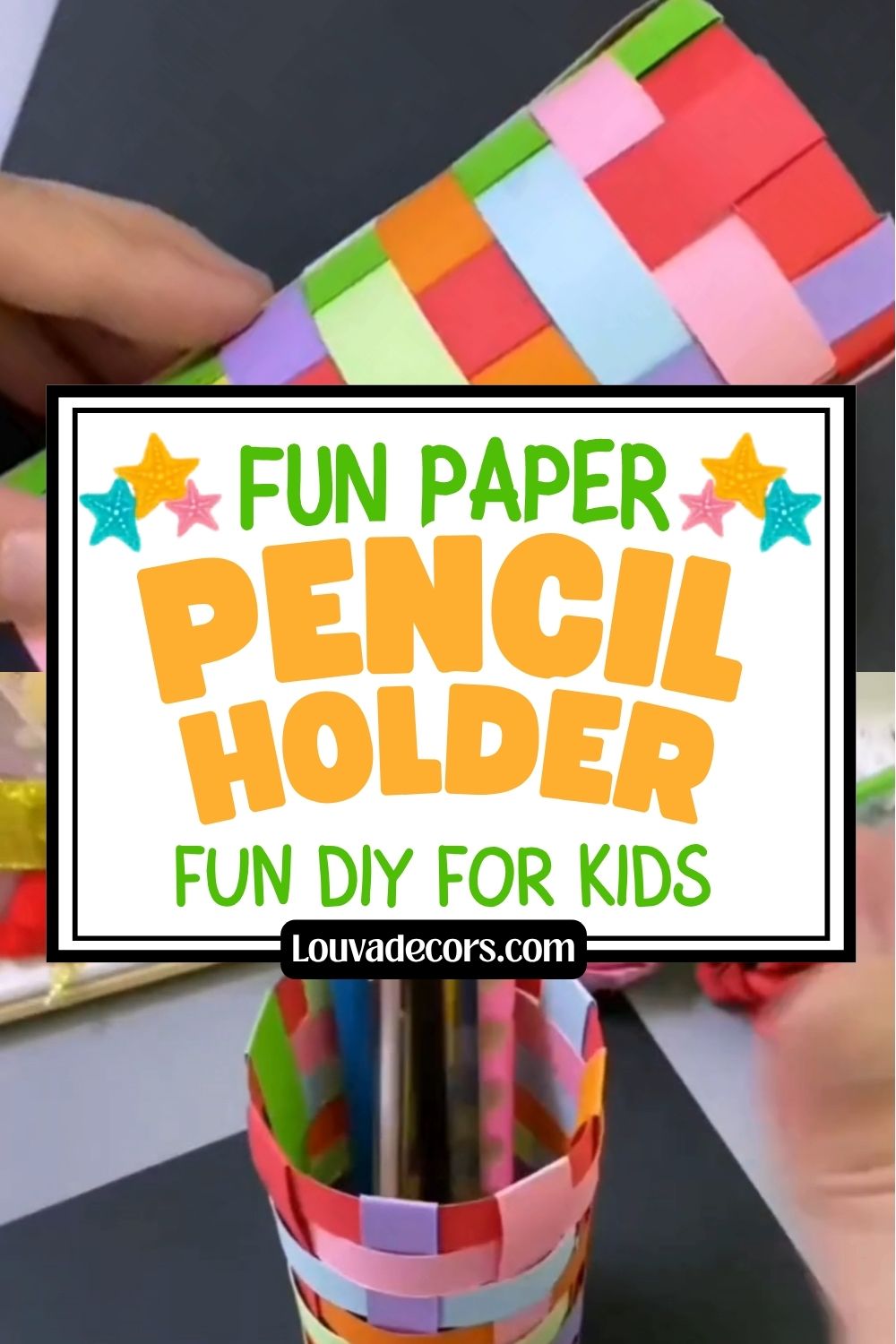
Picture a bright, rainbow-colored pencil holder sitting on your desk woven like a little basket, looking like something you would find in a handmade craft boutique, but made entirely from strips of colored paper you can pick up at any stationery shop for almost nothing. That is exactly what this woven paper pencil holder tutorial will teach you, step by step. It brings together paper weaving craft, colorful desk organization, and beginner paper crafts into one satisfying build you can finish in under an hour.
You do not need any experience, any glue, any scissors skills, or any special tools for this project. The entire build is based on a simple over-under weave that your hands will learn in the first two rows. If you have ever woven a paper placemat in school or braided something with your hands, this will feel familiar and fun from the very first step.
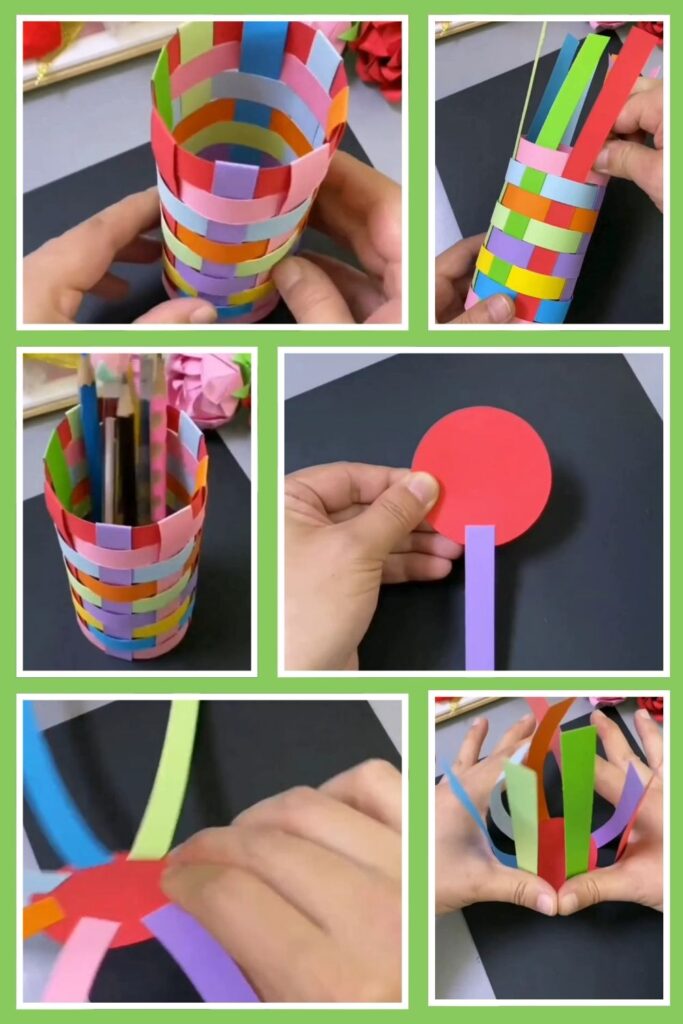
Grab a stack of colored paper in 10 shades you love, and let’s make this together. Everything you need costs roughly $1-2 at your local stationery shop, and the finished holder makes a wonderful handmade gift idea that also doubles as a gorgeous piece of colorful home decor. Your desk is about to look very, very good.
WHY YOU WILL LOVE THIS PROJECT
This woven paper pencil holder looks far more impressive than the time and money it takes to make guests will genuinely ask where you bought it. The basket-weave pattern is beautiful in person, the rainbow of colors is endlessly customizable, and the whole build requires nothing more than paper strips and patient hands. It works perfectly on a child’s study desk, an artist’s worktable, a home office shelf, or a teacher’s classroom and it makes one of the most personal and colorful handmade gifts you can give.
WHAT YOU WILL NEED
- Colored paper strips 10 colors, approx. 1.5–2 cm wide × 30 cm long, 8 strips per color Colors visible in video: purple, blue, light blue, green, lime green, orange, pink, red, yellow, grey [Budget alternative: Cut strips from old magazines, gift wrap, or colored newspaper inserts]
- 1 red circular disc approx. 8–10 cm diameter, cut from cardstock base of the holder [Budget alternative: Trace any round lid or bottle base onto cardstock and cut it out]
- Horizontal ring strips same width as vertical strips, approx. 25–28 cm long pre-formed into circles before weaving [Budget alternative: Use a single accent color for all rings to simplify cutting]
- 1 clear plastic cylinder for internal shaping (optional but recommended) a clean plastic bottle or container used as inner mold [Budget alternative: An old tin can or rolled cardboard tube]
- Scissors only for cutting strips to size before you begin
VIDEO TUTORIAL
Watch the full tutorial above before reading the written steps. The steps below match the video exactly.
STEP-BY-STEP INSTRUCTIONS
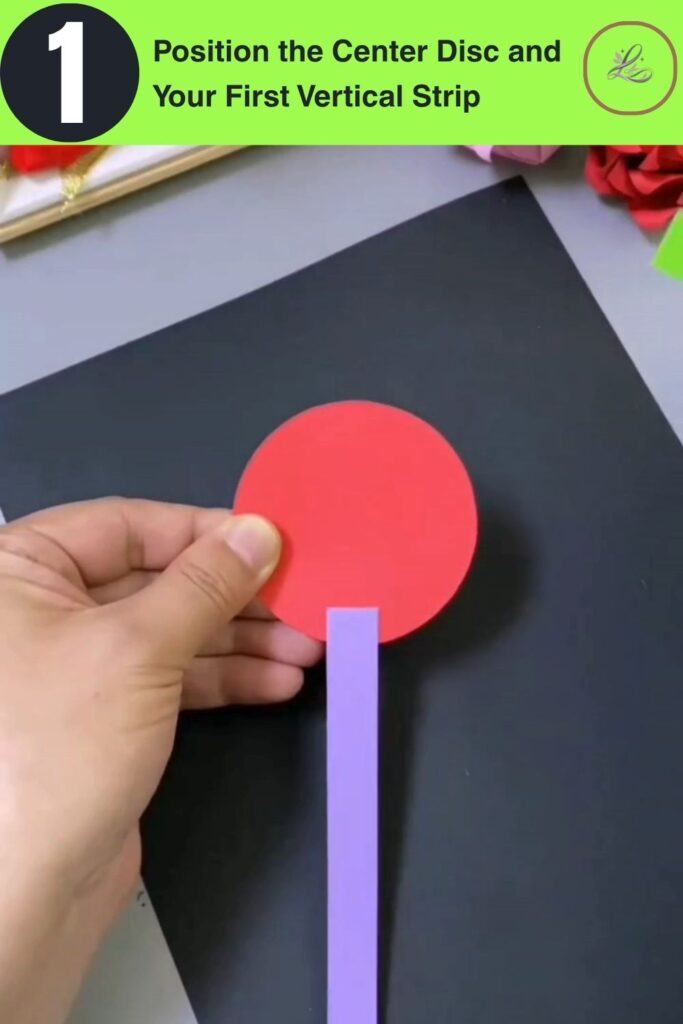
Step 1: Position the Center Disc and Your First Vertical Strip
Begin by holding the red circular disc flat between your fingers. This disc is the base of your pencil holder and the anchor point for every strip you will add. Take your first long paper strip (purple in the video) and slide it vertically through the center of the disc so equal lengths extend from both the top and the bottom. Hold everything loosely for now.
Do not press or glue anything at this stage. The disc and strip will find their grip naturally as you add more strips around them. Take your time getting this first strip placed straight, because it sets the direction for everything that follows.
Pro Tip: Use a slightly thicker cardstock for the center disc 160 GSM or heavier. A flimsy disc will shift and wobble as you add strips, but a firm disc holds its position and gives the whole structure a solid base to build from.
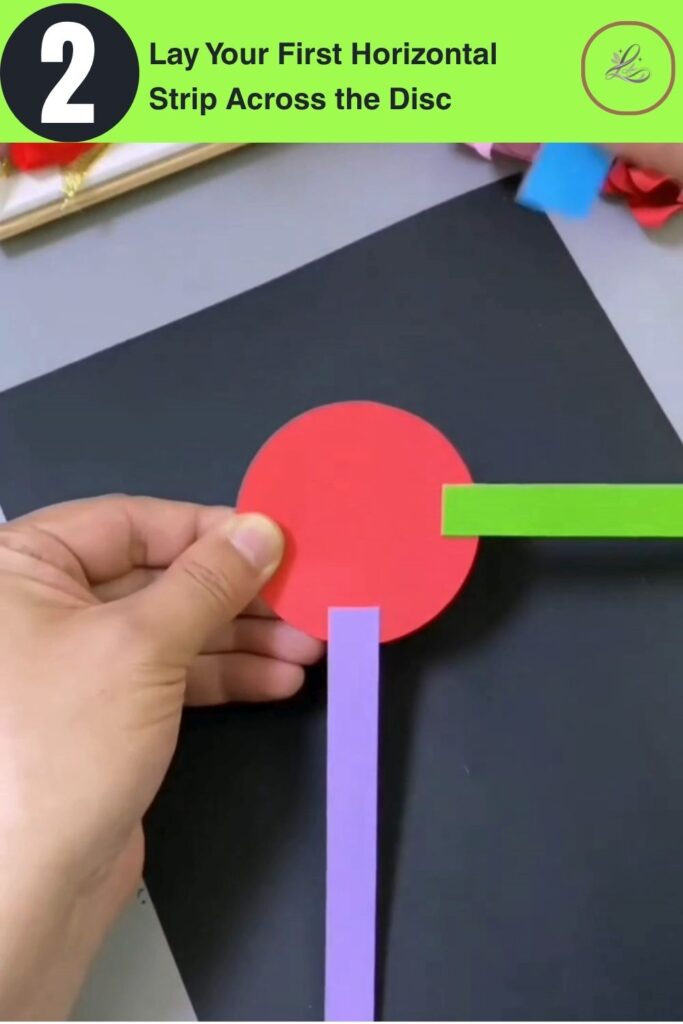
Step 2: Lay Your First Horizontal Strip Across the Disc
Pick up a second strip in a contrasting color (green in the video) and lay it horizontally straight across the center of the disc, crossing the vertical strip you placed in Step 1. Press the two strips against both sides of the disc so they sit flat. You now have a cross shape at the disc’s center.
This is the foundation of your starburst. Each new strip you add in the next step will radiate outward from this same center point, like a wheel with spokes. Keep the center tidy and the strips crossing cleanly for the best result.
Pro Tip: Hold the disc with one hand and use your other hand to guide each strip into position rather than laying it flat and trying to center it from above. Holding it upright gives you much better control over where each strip crosses the disc.
Step 3: Build Out the Full Starburst All 10 Strips
Continue adding the remaining colored strips one by one, each time sliding a new strip across the disc at a slightly different angle from the last, until you have a complete starburst radiating out in all directions. Space the strips as evenly as you can all the way around the disc and aim for roughly equal gaps between each spoke.
In the video, 9–10 strips are placed total, covering the full 360 degrees around the disc. Colors used: purple, blue, light blue, green, lime green, orange, pink, red, yellow, and grey. Press everything together gently once all strips are placed so the disc grips each one.
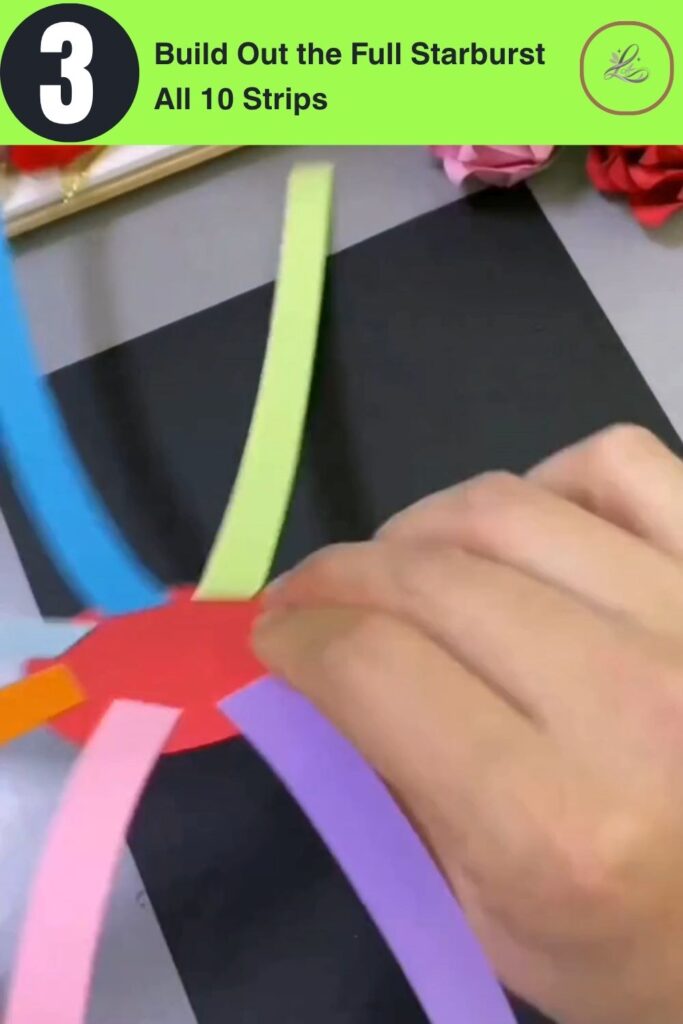
Pro Tip: Count your strips and confirm you have an even number before moving on. An even count is what makes the over-under weave alternate correctly all the way around the cylinder; an odd number will break the pattern at the join.
Step 4: Pre-Form Your Horizontal Ring Strips
Before you start weaving, take each of your horizontal ring strips and gently flex it between both hands a few times so it becomes more pliable and easier to curve into a circle. Hold one end in each hand and run your thumbs along the length to pre-curl it slightly. You are training the paper to bend.
This step is shown clearly in the slowed video: the yellow ring strip appears flat first, then is flexed before being curled into a circle. Pre-forming the strips this way prevents cracking and makes the weaving process much smoother when you slide each ring in and out of the vertical strips.
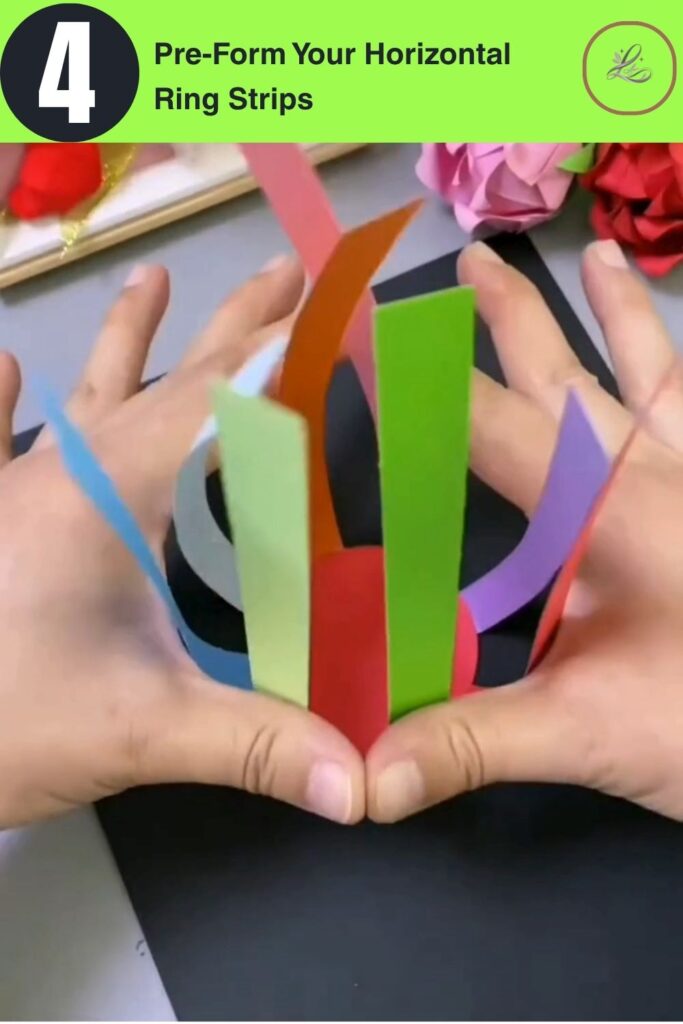
Pro Tip: If your paper feels stiff and crinkles rather than curls smoothly, run the strip over the edge of a ruler or table corner to gently score a soft curve into it. This relaxes the paper fibres and makes curling much more natural.
Step 5: Curl the Ring Strip into a Circle
Bring the two ends of your first ring strip together to form a closed circle overlap them slightly and pinch the join firmly between your fingers to hold the shape. The circle should be just wide enough to slip over the vertical strips of your future cylinder with a little give not so loose it falls off, and not so tight it crumples the verticals.
You can use a tiny strip of tape on the inside of the join to hold it closed, or simply hold it in one hand as you begin weaving it onto the cylinder in the next step. The weaving itself will lock the ring in place.
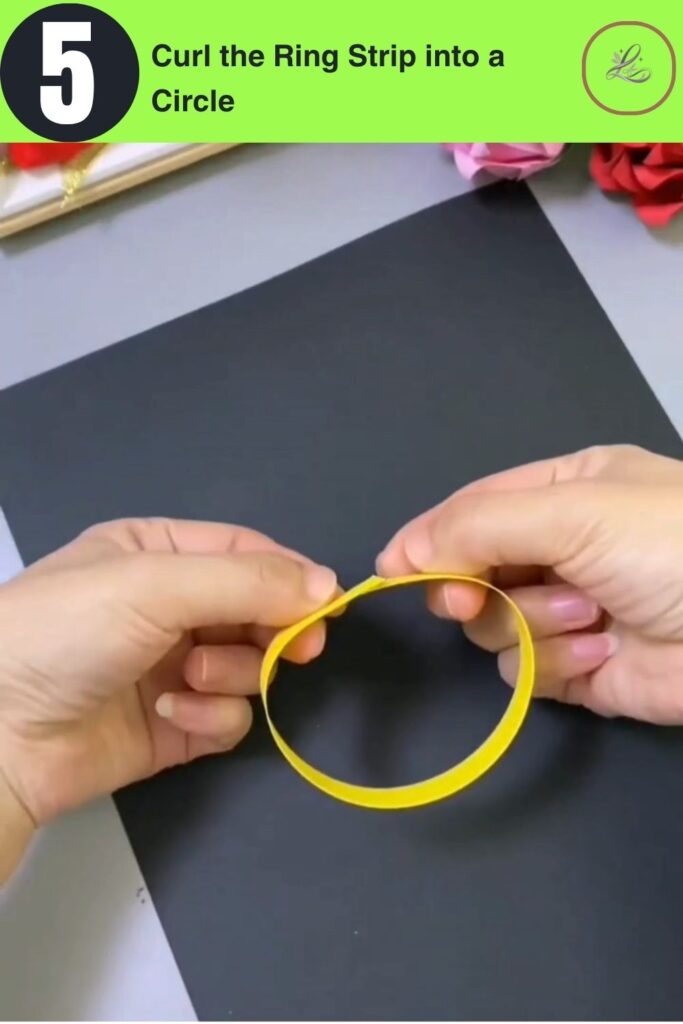
Pro Tip: Match your ring circle diameter to the widest part of your clear plastic bottle or cylinder insert if you are using one. Forming the ring around the bottle before weaving gives you a perfect, consistent size for every row.
- 20 Easy DIY Santa Crafts to Make This Christmas (Cheap & Adorable)
- Lovely Paper Pop Up Tulip Card Anyone Can Make
- Cute Paper Chinese New Year Garland Anyone Can Make
- Adorable Halloween Paper Hat Craft for Beginners
- Make Sweet DIY Flower Greeting Card for Loved Ones
Step 6: Curl the Vertical Strips Upward and Place Your Inner Support
Pick up the full disc-and-starburst assembly in both hands and gently curl all the vertical strips upward together to form a cylinder shape. Cup your hands around the outside and let the strips rise naturally, do not force them or bend them sharply. Place your clear plastic insert or bottle inside the forming cylinder to help it hold a round shape as you weave.
The inner support is visible in the video from frame 10 onward; it is what keeps the cylinder perfectly round while you work. You will remove it after the weaving is complete. At this stage the strips will still be floppy and open at the top, and that is exactly right.
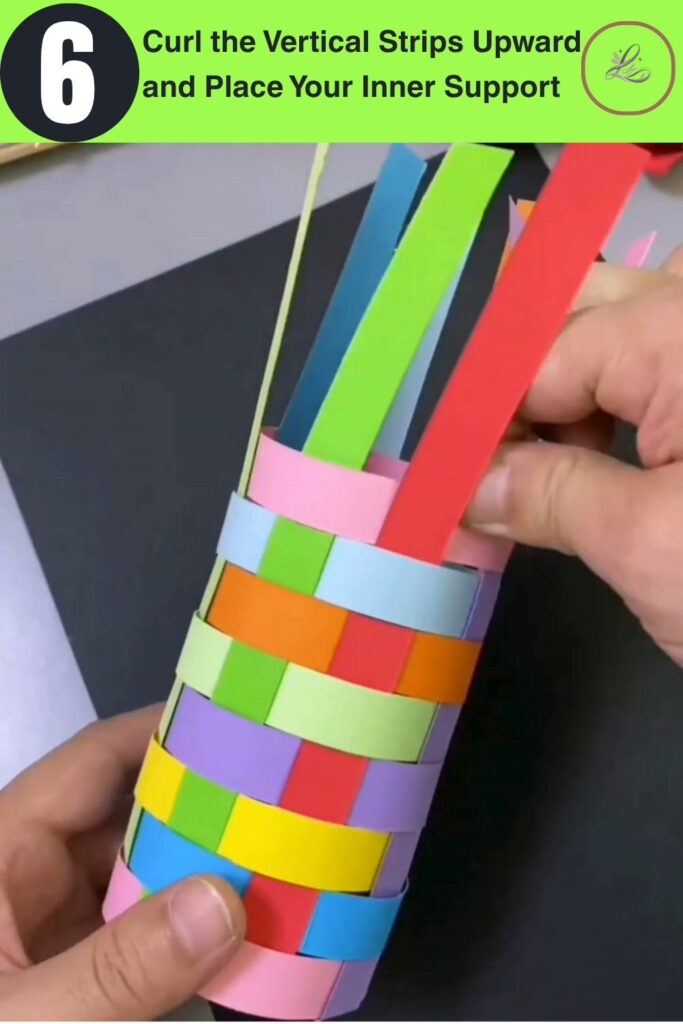
Pro Tip: If you do not have a suitable plastic insert, roll a sheet of thick cardstock into a tube, tape the seam, and use that instead. It works just as well and you can cut it down to any height you need.
Step 7: Weave the Horizontal Rings Up the Cylinder
Slip your first pre-formed ring circle over the top of the cylinder and work it downward, going over one vertical strip then under the next as you move around the full circumference. Pull the ring snug so it sits level, then add the next ring immediately above it but this time begin your weave on the opposite vertical strip so the pattern alternates row by row.
Keep weaving rings upward, one row at a time, pressing each completed row gently down toward the rows below it as you go. The weave becomes denser and more structural with every row you add. This is the most meditative part of the whole project enjoy it.
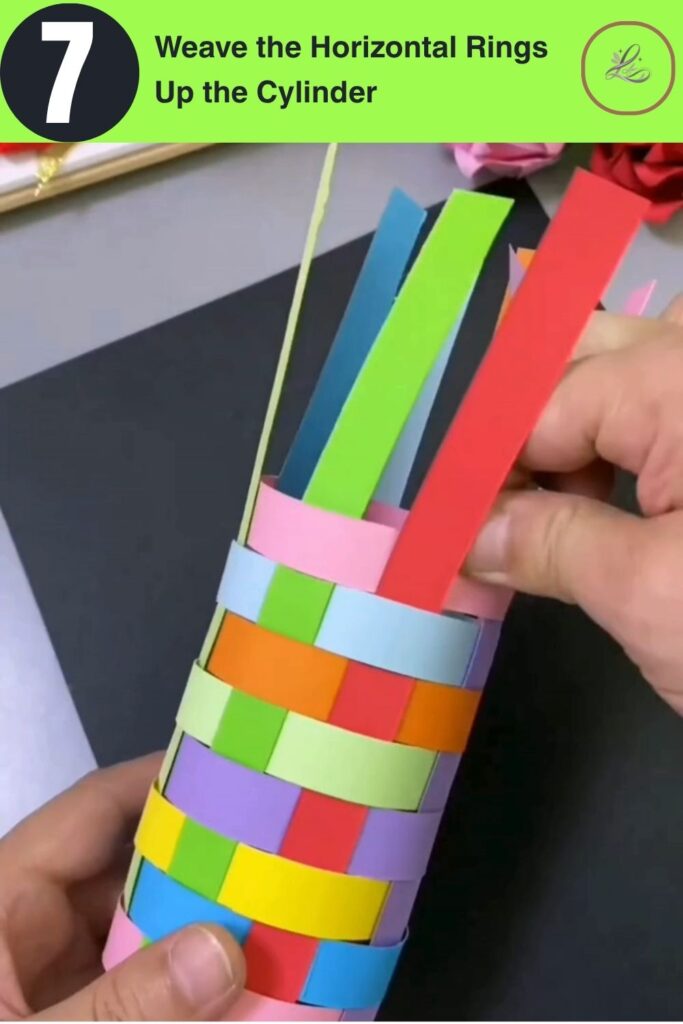
Pro Tip: Rotate the cylinder in your non-dominant hand as you weave with your dominant hand rather than putting it down between rows. Rotating keeps the tension even all the way around and prevents one side from becoming tighter than the other.
Step 8: Fold and Tuck the Top Strip Ends Inward
When you have woven your final ring near the top and the vertical strips still poke out above it, fold each strip tip inward over the top edge of that last ring and press it flat down inside the cylinder. Work your way around the rim one strip at a time, tucking each tip neatly under the ring on the inside.
No glue and no tape are needed. The fold holds itself firmly because the ring strip grips the folded tip from both sides. This is confirmed from the slowed video a clean, tool-free method that gives the rim a neat, professional edge. Take your time with each strip tip and press each fold firmly before moving to the next one.
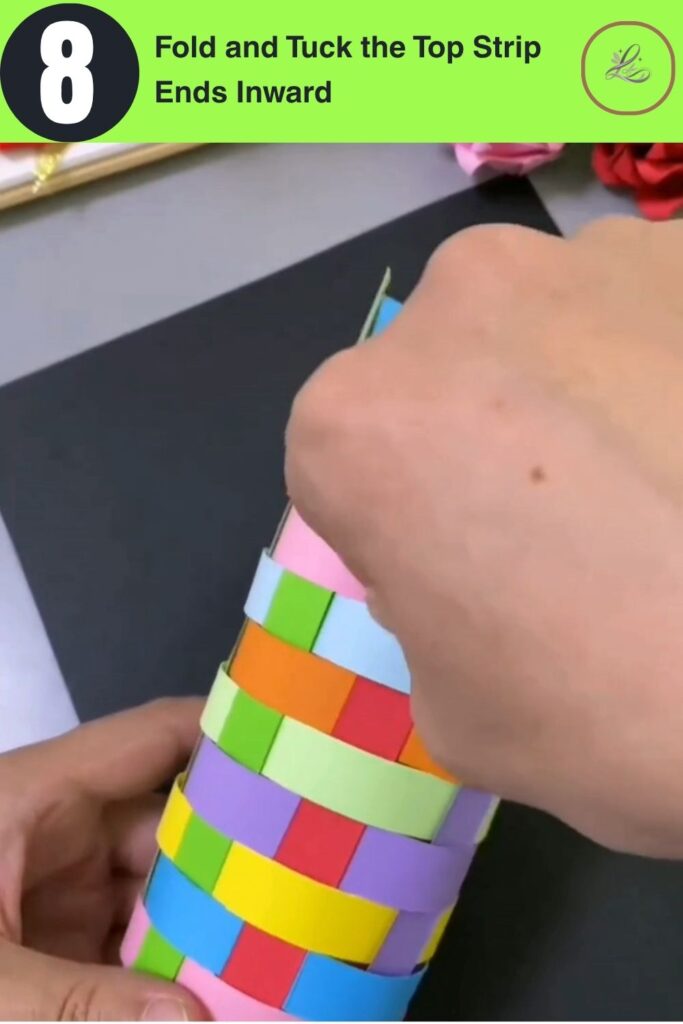
Pro Tip: If a strip tip is too short to fold comfortably over the rim, weave your final ring one row lower so the vertical strip tips are a little longer. An extra centimetre of length makes the folding much easier and the finish much cleaner.
Step 9: Turn the Holder Over and Check the Finish
Once all strip tips are tucked in, turn the finished holder upside down and look at the rim from the inside. Every tip should lie flat and the top edge should look clean and even all the way around. Gently press any tips that are lifting back into place with your thumb.
Remove the inner plastic support by sliding it out from the opening. The holder will hold its shape perfectly without it; the woven rings grip the vertical strips firmly enough to maintain the cylinder form on their own.
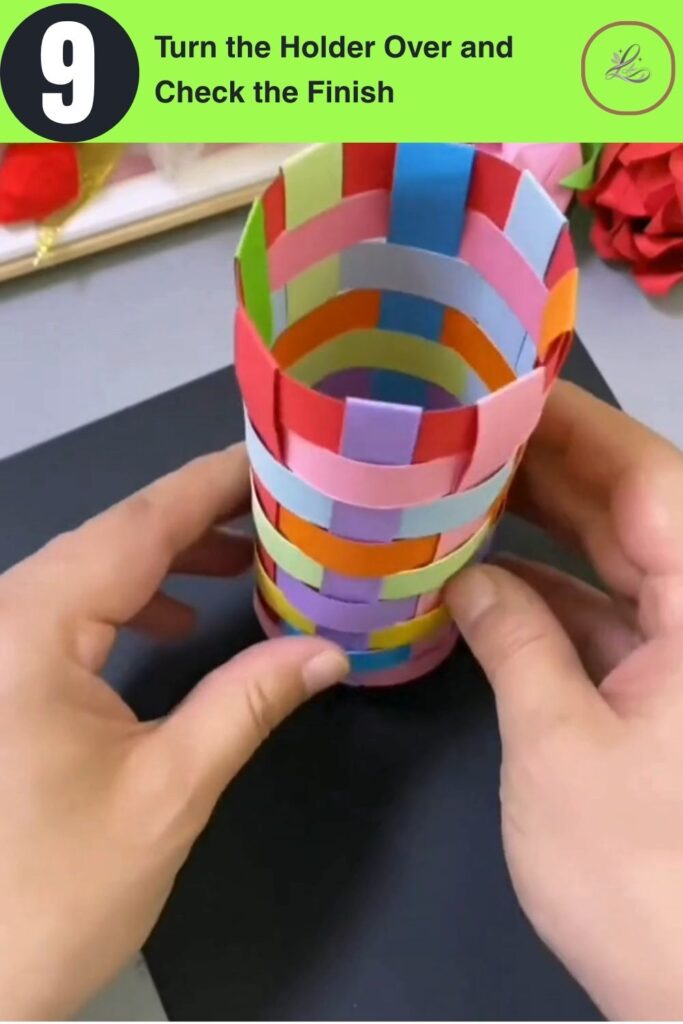
Pro Tip: If the inside of the rim looks a little uneven, do not worry. Most of this is hidden once the holder is standing upright. Run your thumb around the inside rim one final time to press everything flat, and the outside will look perfectly finished.
Step 10: Fill With Pencils and Display
Stand your completed woven paper pencil holder upright on your desk and load it with your favorite pencils, pens, brushes, a ruler, anything you want to keep organized and close at hand. Give the outside one final gentle press all the way around so every ring sits perfectly snug.
Look at what you made. That beautiful, colorful, basket-woven desk organizer came from nothing but strips of paper and your own two hands and it cost almost nothing. That is the quiet magic of paper weaving craft, and you have just made something genuinely wonderful.
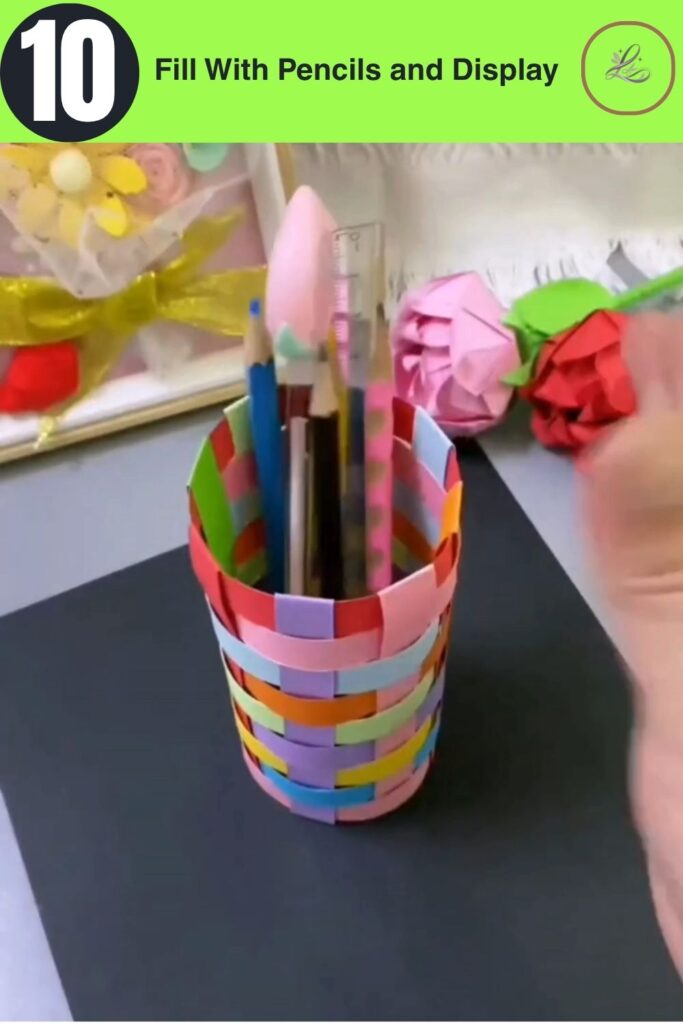
Pro Tip: For extra durability, especially if children will handle this holder regularly, brush the outside lightly with one thin coat of diluted PVA craft glue (50% glue, 50% water) and let it dry for an hour. This hardens the paper weave into an almost rigid structure without changing the look.
TIPS & TRICKS
1. What to do if your cylinder keeps leaning to one side: This almost always means your vertical strips are not all the same length. Before you start building, lay all your strips side by side and trim any that are longer than the others. Even a 1–2 cm difference in length will cause the holder to tilt as you weave upward.
2. What to do if a ring strip tears while weaving: Remove the torn ring entirely and replace it with a fresh pre-formed ring in the same color. Weave the replacement in, making sure you start the over-under pattern in the same position the torn ring started in. The weave pattern will close around the new ring and the repair will be invisible.
3. How to choose the right plastic insert: The insert diameter directly determines how wide your finished holder will be. A standard 500ml plastic bottle gives you a holder wide enough for a good bunch of pens and pencils. A narrower bottle gives you a sleeker, taller look. Test the fit before you start curling your strips upward.
4. How to tighten a loose weave after finishing: If you notice gaps in the weave once you are done, slide each horizontal ring upward against the row above it using your thumbnail. Work your way around the full circumference of each ring before moving to the next ring up. The weave will compress and tighten noticeably.
5. What if the fold-and-tuck finish keeps popping open: This happens when the vertical strip tips are very short. If a tip is less than about 1.5 cm, it will not grip the inside of the last ring reliably. For those strips, fold the tip and secure it with one tiny piece of tape on the inside of the rim completely hidden, and the outside looks identical.
WAYS TO USE THIS CRAFT
Your woven paper pencil holder has many more uses than it might seem at first glance. On a study desk it keeps pencils, pens, highlighters, and rulers beautifully organized. On an artist’s table it holds brushes and colour pencils. In a home office it corrals markers, scissors, and correction pens, a far cheerier alternative to a plain plastic mug.
These holders also make some of the most personal handmade gifts you can give. Match the colors to a friend’s room, a teacher’s classroom palette, or a child’s favorite shades. Fill it with a set of colored pencils or a small notebook and you have a complete, beautiful present that costs almost nothing but looks genuinely thoughtful. During Diwali, Christmas, or back-to-school season, a rainbow woven holder makes a delightful, original gift that nobody else will give.
FREQUENTLY ASKED QUESTIONS
-
How long does this project take to complete?
For a first attempt, allow 30–45 minutes; most of that time goes into cutting all your paper strips to the same length before you start. Once your strips are ready and your ring circles are pre-formed, the actual weaving goes faster than you might expect. With a little practice, you can complete a woven paper pencil holder in around 20 minutes from start to finish.
-
What if I make a mistake can I fix it?
Absolutely. The best part of this weaving method is that each horizontal ring slides off and back on independently. If you notice a weaving error in one row, slide that ring off, recount your starting position, and slide it back on correctly. Nothing below it is affected. Take your time and check each row as you go rather than at the end.
-
Where can I buy the materials for this project?
Colored paper strips, cardstock, and scissors are all standard stationery items available at any local stationery shop or craft store. In India, look for them at D-Mart, Crossword, local stationery marts, or any school supply shop. For a wider color range or bulk packs, Amazon and Flipkart both carry colored cardstock sets that work perfectly for this project.
-
Can I make this pencil holder without using any glue at all?
Yes and this video proves it beautifully. The over-under weave holds every horizontal ring firmly in place, and the top rim is finished with a fold-and-tuck technique where each vertical strip tip folds inward over the final ring and stays held by the tension of the weave. No glue, no tape, no glue gun needed anywhere in the build. This makes the woven paper pencil holder a brilliant project to do with children of any age.
-
What size should I cut my paper strips for this project?
Cut your vertical strips approximately 30 cm long and 1.5–2 cm wide. For your horizontal ring strips, 25–28 cm in length gives you a ring that closes snugly around a standard cylinder of about 7–8 cm diameter. These measurements will produce a finished holder approximately 10–11 cm tall roomy enough for a full bunch of pencils, pens, and a small ruler.
CLOSING
Look at what you built: a colorful, cheerful, completely handmade pencil holder made of nothing but paper strips, patient hands, and a simple weave. It costs almost nothing to make, it looks beautiful on any desk, and it is the kind of thing people genuinely stop and ask about. Put your favorite pens and pencils in it, set it where you can see it every day, and enjoy a small piece of handmade joy that you created yourself.
Ready to keep making? Try Paper Flower Wall Decoration Easy DIY for Beginners next your hands are already warmed up and ready.
Happy crafting! LOUVADECORES
Follow us on: Pinterest
